The scientist who painted the brain

Kim Sang-hyun
The author is a professor of mathematics at Korea Institute for Advanced Study.
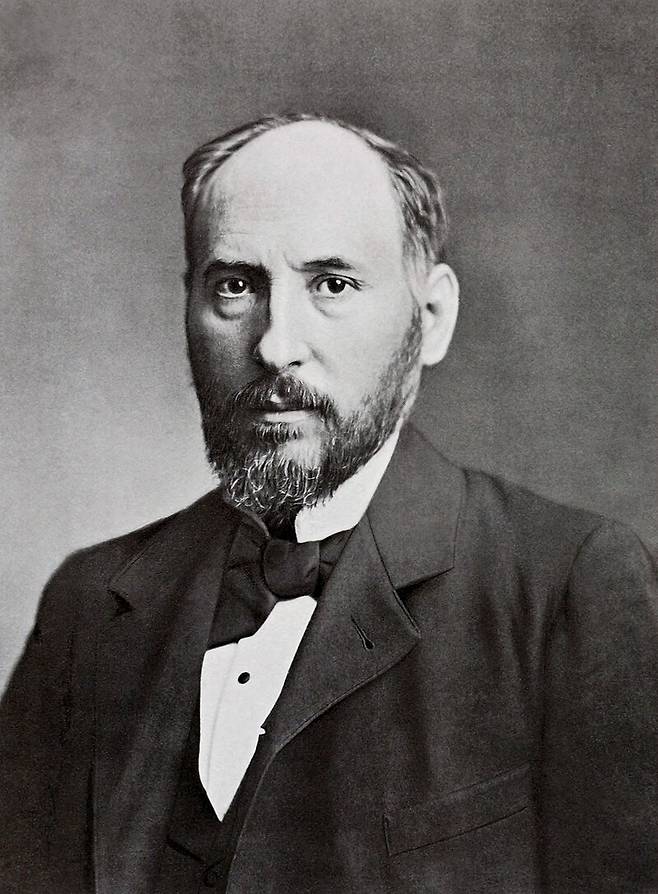
As a boy, his dream was to become a painter. His textbooks and notebooks were filled with his sketches, leaving little room for class notes. He had no interest in formal lessons, much to his father’s concern. At age 11, he suffered a serious injury while experimenting with homemade explosives. After recovering, he found a new passion — observing and sketching nature. This was the childhood of Santiago Ramón y Cajal (1852–1934), the Spanish neurologist who would later revolutionize our understanding of the brain.
Cajal grew up in a country that was a peripheral player in the world of science, and his work initially received little attention. Yet, through meticulous observation and exhaustive sketching, he decoded the architecture of the brain. His greatest discovery came when he revealed that neurons are individual units, connected by tiny gaps called synapses — an insight that overturned the prevailing belief that the brain was a single, continuous network. By the time he was awarded the Nobel Prize in 1906, he had already earned the title “Father of Neuroscience.” His intricate anatomical drawings remain masterpieces, intersecting both science and art, and are still featured in textbooks today.
When we graduate from school, we each possess a specialized tool, a particular skill set that defines our field of study. In academia, this specialization only deepens. Yet, as we encounter the achievements of others, we sometimes feel envious, as if our hammer is inadequate compared to someone else’s heavy machinery. It is tempting to believe that by collecting multiple tools, we might accomplish even greater things.
But Cajal warned against this mindset. In “Advice for a Young Investigator”(1987), a collection of Cajal's essays, he cautioned that too much breadth can be a researcher’s downfall.
“Let us sharpen a single blade, at most two. Focus our analytical strength so that we may pierce straight to the heart of the problem.”
Perhaps, we are all sharpening our own hammers throughout life. If we refine our skills with precision and patience, we will inevitably find the right nail to strike — a moment where our unique expertise is indispensable. And in that moment, we realize why our hammer — our individuality — matters.
Translated using generative AI and edited by Korea JoongAng Daily staff.
Copyright © 코리아중앙데일리. 무단전재 및 재배포 금지.
- Korea's new 'top-tier' visa offers various perks to attract select foreign professionals
- Trump says Korea wants to join Alaska LNG project for 'trillions of dollars'
- Exclusive: LG Energy's Arizona battery plant to start mass production in first half of 2026
- Trump points to South Korea as a nation unfairly benefiting from U.S. military support
- Pocheon village in ruin after Korean Air Force fighter jet misfires
- Tariffs, military 'help' and subsidies: Trump dismantles dynamic with Korea in Congressional address
- 'Aren't you ashamed?': Agency CEO MC Mong accuses SM of underhanded practices in Xiumin, KBS ordeal
- U.S. defense official confirms 2nd deployment of North Korean troops to Ukraine-Russia conflict
- L.A. Dodgers' Kim Hye-seong not favorite for opening day roster
- Philippine flight foul-up leaves some 170 Jeju-bound travelers stranded