The fragile authority of justice

Chun Young-paik The author is a professor of art history and visual philosophy at Hongik University. The law is to be fair to all, and the courtroom is sacred; this is what we have been taught. But these days, it seems even the courts are in turmoil. The judiciary, especially the Constitutional Court — currently under intense public scrutiny — is facing waves of satire and criticism. On a positive note, this may indicate that the judicial system has become more transparent. Like fish in a glass tank, the courts are now under the watchful eyes of many.
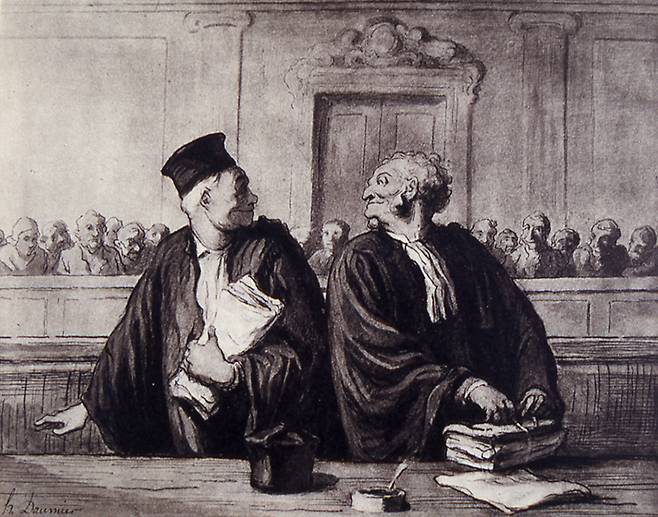
In art history, one particular work vividly illustrates this issue: Honoré Daumier (1808–1879)’s lithograph “After the Trial," a piece estimated to be from the 1840s. The expressions of the judges — who should be handling trials with utmost care — are disgraceful. They look as if they have just carelessly wrapped up a tedious and bothersome task, exuding a sense of arrogance and contempt. Their attitude starkly contrasts with the anxious and earnest citizens waiting in the background for the verdict.
Since ancient times, the courtroom has been regarded as an inviolable realm, and judges have wielded authority comparable to that of deities. However, within those sacred walls, corruption and injustice have often thrived. Daumier, with his sharp brushwork, exposed this reality in its rawest form.
Having lived through the upheavals of the French Revolution in the early 19th century, Daumier was an artist who boldly critiqued the ruling elite through caricatures in popular newspapers. His works were featured in weekly publications designed for the largely illiterate masses. His lithographs frequently targeted corrupt officials, unjust judges and unscrupulous lawyers. With quick, spontaneous sketches, he captured their postures and expressions, revealing their psychological depths. Daumier was a genius at delivering the essence of caricature — concise depiction, effective communication and sharp wit. Later, he would be recognized for elevating newspaper satire to the level of significant artistic achievement.
The Realism movement, to which Daumier belonged, surged in the mid-19th century, driven by artists who sought to critique society. Rejecting the rigid structures of Neoclassicism and the subjective emotions of Romanticism, Realists confronted harsh realities with an unflinching gaze. These artists combined intellectual critique with meticulous, lifelike depictions of contemporary society.
If Realism used direct, blunt language to expose corruption, the Symbolism movement of the late 19th century adopted a more suggestive and metaphorical approach. James Ensor (1860–1949), a prominent figure in Belgian Symbolism, was well known for his extensive use of mask motifs in his works. These masks served as a powerful metaphor for deception and falsehood, reflecting both his hometown’s carnival traditions and his deep-seated critique of society.
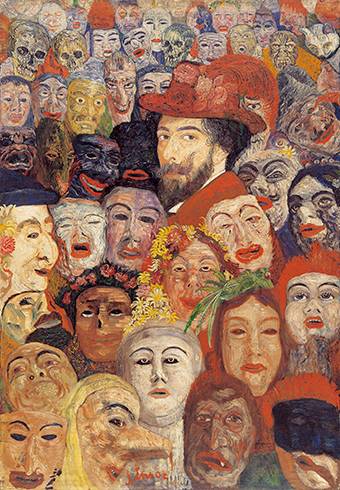
In his painting “Self-Portrait with Masks (1899),” Ensor portrays himself surrounded by grotesque masks. These masks create a dark, ominous atmosphere, symbolizing the corruption and hypocrisy of the politically chaotic society of his time. However, unlike the eerie masks around him, Ensor’s face remains calm, contemplative and even illuminated — standing out amid the deceit. His exposed, unmasked face represents an artist’s self-awareness and fearless confrontation with reality.
Amid the current turbulence in our society, one can only hope that the faces of Korea’s most esteemed judges will resemble Ensor’s self-portrait — standing firm and dignified. May they remain unshaken by any political force wearing the masks of corruption and deceit, and may they shine with the light of truth, guided solely by the law and their conscience.
Translated using generative AI and edited by Korea JoongAng Daily staff.
Copyright © 코리아중앙데일리. 무단전재 및 재배포 금지.
- Korea on edge as 'America First' expands to nontariff trade barriers
- Felix of Stray Kids breaks bone in car accident after meet and greet
- [WHY] Black, not pink: Why Jennie's outfit encapsulated the Korean wedding dress code
- Why everyone is rushing to buy gold — except the Bank of Korea
- Red-hot gold prices get extra kick with 'kimchi premium' in Korea
- Be my Valentine: Singles search for love at Seoul city blind dating event
- [VIDEO] Spurs prepare for Man United clash
- Charcoal artist Lee Bae's moon house project comes full circle with fiery finish
- Power banks, e-cigarettes banned from overhead bins on Korean-owned airlines
- Korean delegation to visit White House to discuss cooperation in face of tariffs