AI chip boom fuels heat management technology development
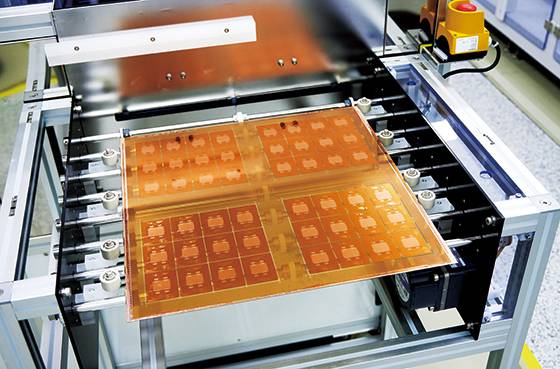
According to industry sources, South Korean chipmakers are accelerating the development of next-generation technologies aimed at improving power efficiency and addressing heat challenges in AI semiconductors. High-performance AI chips consume large amounts of power for fast processing speeds and complex tasks, generating significant heat and making thermal control a critical challenge.
Among emerging solutions, glass substrates are gaining attention as a potential breakthrough in semiconductor heat management. Offering better heat resistance and reduced warping compared to conventional plastic substrates, glass is ideal for high-density AI semiconductor packaging. However, challenges remain in commercialization due to low yields and fragility.
Several Korean companies are working to bring glass substrates to market. Samsung Electro-Mechanics Co. revealed its roadmap to mass-produce glass substrates by 2027 at Consumer Electronics Show (CES) 2025 in January, with plans for client sample testing. Given its history of supplying high-value substrates to major tech firms, Samsung Electro-Mechanics is expected to commercialize the technology ahead of competitors.
SKC Ltd. is also advancing its glass substrate production. The company is operating the world’s first glass substrate mass production plant in Covington, Georgia, via its subsidiary Absolics Inc., and plans to leverage three years of accumulated expertise to gain a competitive edge.
LG Innotek Co. is investing in facilities and plans to begin pilot production of glass substrates by the end of 2025.
Several domestic suppliers, including Chemtronics Co. (chemical processing), Philoptics Co. (drilling), Joongwoo M-Tech Co. (drilling), and Avaco Co. (equipment), are working closely with Samsung, SK, and LG to support commercialization and mass production.
Immersion cooling is another key heat management technology. This process involves submerging electronic components in cooling fluid to absorb and dissipate heat or directly contacting components with liquid to regulate temperature. The technology gained momentum after Nvidia Corp. incorporated immersion cooling in its next-generation AI accelerator, Blackwell.
SK enmove Co. demonstrated an AI server cooling system using immersion cooling fluid at CES 2025, while other Korean refiners, including GS Caltex Corp., S-Oil Corp., and HD Hyundai Oilbank Co., also showcased their immersion cooling solutions.
Silicon photonics technology is also gaining traction as a heat management solution. By using optical signals instead of electrical signals to process data, silicon photonics reduces heat generation in semiconductor devices.
Taiwan Semiconductor Manufacturing Co. recently announced it is researching silicon photonics. Samsung Electronics unveiled its silicon photonics development roadmap at the Samsung Foundry Forum 2024, while Intel Corp. is also advancing research in the field.
Copyright © 매일경제 & mk.co.kr. 무단 전재, 재배포 및 AI학습 이용 금지
- 오늘의 운세 2025년 2월 3일 月(음력 1월 6일) - 매일경제
- 인천공항서 작년 압수된 김치 무려 11t, 어디로 갔을까 - 매일경제
- 중산층으로 번진 '금소세'… 납부자 1년새 75% 급증 - 매일경제
- ‘사의 표명’ 김대호 “출연료 1시간에 4만원…광고 15개나 놓쳐” - 매일경제
- 대왕고래 이어 마귀상어 … 동해서 또 유전 - 매일경제
- “美주식으로 돈 쉽게 버는 시대 끝나”…월가의 전설, 서학개미에 경고 날렸다는데 - 매일경제
- “반도체는 주52시간 제외할 수도”…딥시크에 놀란 野, 반도체법·AI추경 급물살 - 매일경제
- [단독] 요즘 강남 사람들 ‘여기’ 몰린다…불황에도 매출 목표치 2배 넘은 이 쇼핑몰 - 매일경제
- 한순간에 잿더미된 덕유산 설천봉 ‘상제루’…1시간50여분만에 진화, 무슨 일 - 매일경제
- ‘손흥민, 자책골 유도 + 7호 도움 맹활약!’…토트넘, 8경기 만에 이겼다! → 브렌트포드전 2-0 승