A walk through the roots of traditional crafts
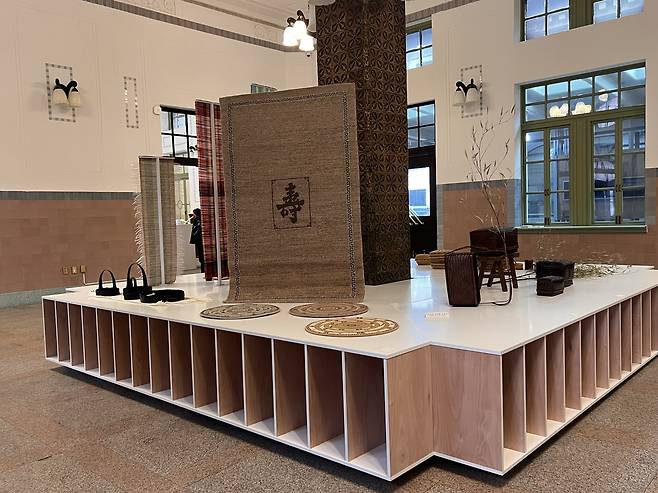
The traditional crafts of artisans often reflect the customs and stories of the people who kept their rich heritage alive for future generations by creating highly detailed works such as jewelry, pottery and textiles.
Placing value on traditional art forms and how they have become a pivotal aspect of South Korea's cultural heritage, an exhibition entitled "Craft Journey: All Over the Place, Everywhere," organized by the Korean Craft and Design Foundation, explores the country's abundant history through craftworks.
The fair, which kicked off Wednesday at Culture Station Seoul 284, in the old Seoul Station, showcases reinterpretations of traditional craft practices in contemporary contexts. Centering on the harmony between the old and the new, a total of 68 pieces created by 29 artisans are presented.
The exhibition guides visitors through the regional characteristics of traditional crafts in seven separate zones.
The first space, "Blue Dawn, White Land," presents the beauty of Saetgol, Naju, South Jeolla Province, where artisans have been dying cotton fabric with indigo for over three decades. The next room, "The Wind from the West," takes visitors through the Korean Peninsula to show how artisans use fibrous plants such as cyperus exaltations, bamboo and mulberry paper to create cushions, basketry and lunch boxes.
White porcelain pieces inspired by the natural beauty of Sinchon-ri on Jeju Island are displayed in the "Glimmer of Shinchon-ri" section. The items incorporate ocean-inspired blue and green tones to reflect the colors of the island's waters.
Stepping into "Sitting by the Nam River," visitors can explore Jinju, a city in South Gyeongsang Province known for its history of education, where materials to make wooden furniture and silk for "yangban," or the noble class, were developed.
An exhibition visitor, Jeong Da-hee, a 24-year-old college student in Seoul, said she connected with traditional culture through her interest in traditional Korean instruments.
"Cultural traditions are at risk of disappearing in the age of modernity, but the exhibition allows us to delve into our cultural heritage. Such experiences are usually available in cultural sites like the Hanok Village in Jeonju, (North Jeolla Province), but people can now access cultural opportunities near Seoul City Hall," Jeong told The Korea Herald.
"The Color Threads of ShinSaimdang" pays tribute to Shin Saimdang (1504-1551), an accomplished artist, writer, calligraphist and poet with roots in Gangneung, Gangwon Province. She was also the mother of renowned Joseon-period Confucian scholar Yi Yulgok (1536-1584). The region boasts classical yet sophisticated embroidery styles, and this space at the exhibition presents Korean roof tiles made using traditional hand embroidery and machine embroidery techniques on textiles.
The traditional dining customs of Jeju Island are the subject of "The Legend of Tamna" section that displays how food was prepared for Jeju gods and family.
The exhibition runs until Feb. 11. It is open from 11 a.m. to 7 p.m. every day except Mondays and Seollal on Jan. 29. Admission is free.
Copyright © 코리아헤럴드. 무단전재 및 재배포 금지.