Former Defense Minister says opposition’s suspicions over Myung’s suspected involvement in candidate nominations for elections is one of reasons for martial law declaration
이 글자크기로 변경됩니다.
(예시) 가장 빠른 뉴스가 있고 다양한 정보, 쌍방향 소통이 숨쉬는 다음뉴스를 만나보세요. 다음뉴스는 국내외 주요이슈와 실시간 속보, 문화생활 및 다양한 분야의 뉴스를 입체적으로 전달하고 있습니다.
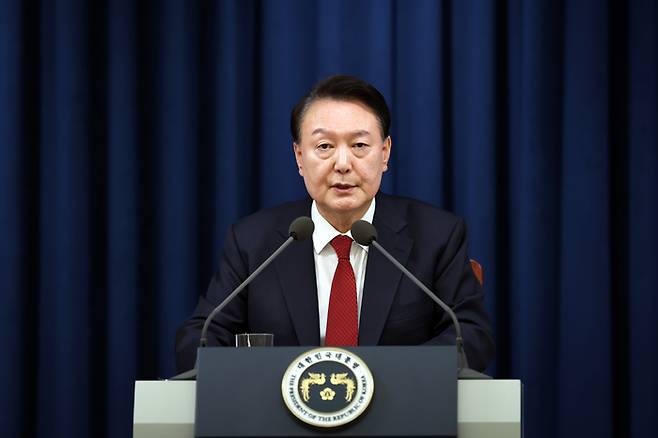
Prosecutors investigating President Yoon Suk Yeol's martial law imposition last month arrested and indicted former Defense Minister Kim Yong-hyun on December 27 last year, said that the “Myung Tae-kyun’s suspected involvement in the ruling party’s candidate nominations for elections" was one of the reasons for Yoon’s declaration of martial law. Contrary to Yoon's assertion that it was an “unarmed and warning martial law,” the martial law forces were armed with nearly 60,000 rounds of live ammunition for their operations.
In the indictment against Kim, obtained by Kyunghyang Shinmun on January 5 through Democratic Party of Korea (DPK) lawmaker Kim Yong-min, the word “president,” referring to Yoon, appears 130 times in the text. The number of times in which the name of “Yoon Suk-yeol” was specified stood at a whopping 87 times. Considering that the word “defendant” referring to the former minister appears 113 times in the indictment, it is safe to say that it is actually an indictment against President Yoon.
According to the indictment, from March to April last year, before and after the 22nd general election, Yoon frequently talked about things alluding to martial law, such as "emergency measures," in private with military commanders who were mainly involved in operations during the short-lived martial law imposition. In particular, on November 24 last year, nine days before the declaration of martial law, Yoon called former Minister Kim privately and raised the level of his remarks like, ”Is this a country? Special measures are needed to make a right country for future generations,” after criticizing the opposition parties raising suspicions over Myung’s involvement in the ruling party’s candidate nominations for elections and mentioning the possibility of impeachment of judges and prosecutors related to investigations into Lee Jae-myung, the leader of the main opposition DPK.
The prosecution believes that key commanders were aware of the possibility of declaring martial law in advance.
According to the investigation, Kim introduced Yeo In-hyung, then the chief of the Defense Counterintelligence Command, Lt. Gen. Kwak Jong-geun, then the chief of the Army Special Warfare Command, Lt. Gen. Lee Jin-woo, then the chief of the Capital Defense Command, and Lt. Gen. Kang Ho-pil, the chief of the Army Ground Operations Command, as “generals loyal to the president” at a dinner with Yoon in June last year. A month before the declaration of martial law, Yoon reportedly dined with Kwak and Lee and asked them what their respective commands would do if martial law was declared, and they each said they would be “well prepared and ready to go.”
On the day of martial law declaration, Yoon pushed ahead with it despite objections from some cabinet members.
According to Kim's indictment, Prime Minister Han Duck-soo, Deputy Prime Minister and Minister of Economy and Finance Choi Sang-mok, and Foreign Minister Cho Tae-yul opposed the declaration of martial law at a Cabinet meeting before the martial law was declared, saying, "It has a fatal impact on the country’s economy and diplomacy." However, Yoon went ahead with the declaration, saying, “If we leave pro-North Korean leftists like this, the country will be in trouble,” “If we change the plan now, everything will go wrong,” and “It's the president's decision.”
Prosecutors wrote in the indictment that Yoon's unilateral decision violated the procedures set out in the constitution and martial law. No minutes of the cabinet meeting were taken at the time. The Constitution requires the president to declare emergency martial law after deliberation by a Cabinet meeting and the relevant documents must be signed by cabinet members. The prosecution believed that the domestic political and social situation at the time did not even meet the requirements for martial law declaration, such as "wartime or extraordinary circumstances.”
Yoon prepared and implemented the martial law declaration in close communication with the former defense minister and military commanders. After the declaration of martial law, Kim said at a meeting of military commanders that, "From now on, the entire military is led by me. If you do not comply with the order, you will be punished for mutiny."
The prosecution's indictment also included Yoon's specific orders and the process of their implementation. According to the indictment, the Defense Counterintelligence Command first dispatched a five-member “team to arrest Lee Jae-myung” to the National Assembly at around 0:25 a.m. on December 4 last year. Starting with the team for Lee’s arrest, there were 10 teams and 49 people who attempted to enter the National Assembly by 1:15 a.m. on the same day.
President Yoon claims that it was a “warning and unarmed martial law.” However, the prosecution's investigation found a number of facts that contradict this. The investigation found that at least 57,000 rounds of live ammunition were used during the short-lived martial law imposition.
Intelligence agents tasked with taking control of the National Election Commission were armed with live ammunition and stationed near the commission. Shortly after the declaration of martial law, Yoon met with then Deputy Prime Minister Choi and handed him a document instructing him to “completely cut off the current funds related to the National Assembly and draw up a budget for a national emergency legislative organization.”
Even after the National Assembly voted to lift martial law, President Yoon's attempt to continue the operation was also detected. After the lifting of martial law was passed, Kim asked Kwak after a meeting with Yoon, “Can we send troops to the National Election Commission again?” Only after Kwak replied, “It's difficult,” did Kim admit the operation's failure to military commanders, saying, “It was not the result that we wanted.”
※This article has undergone review by a professional translator after being translated by an AI translation tool.
Copyright © 경향신문. 무단전재 및 재배포 금지.
- [속보]법원, 윤석열 ‘명태균 무상 여론조사’ 1심 징역 2년
- 정청래 “당대표직 이용해 대선 출마 안 할 것”…당대표 출마 선언
- [속보]박홍근 예산처 장관 “내년 예산 800조원대로”···올해보다 10% 이상 확대 편성
- 한달째 미궁 통영 60대 살인 사건···제보자에 최고 1억 신고보상금
- 장윤기 “강간 등 살인 인정”···피해자 측 “반성문, 형량 감경 꼼수”
- [의원님은 수주왕] ‘수주왕’을 공개합니다…전수조사로 드러난 수의계약 의혹 지방의원은 누
- [의원님은 수주왕][단독]실적도 없었는데 당선 후 ‘싹쓸이’···군수 조카와 측근들, 영양군 수
- 법원, ‘삼성전자 직원 SK하이닉스 전직 금지’ 가처분 일부 인용···“기술 보호 가치 커”
- [속보]코스피 8% 폭락에 서킷브레이커···삼전·닉스 양대장 추락에 7000선 붕괴
- “다 반값이네” 파산 위기 홈플러스에 몰려든 사람들···남은 1주 극적 반전 가능할까