“I translate and write novels,” says first Korean Booker Prize judge
이 글자크기로 변경됩니다.
(예시) 가장 빠른 뉴스가 있고 다양한 정보, 쌍방향 소통이 숨쉬는 다음뉴스를 만나보세요. 다음뉴스는 국내외 주요이슈와 실시간 속보, 문화생활 및 다양한 분야의 뉴스를 입체적으로 전달하고 있습니다.
“If I don’t do it, nobody will. My work, my job - I built it myself.”
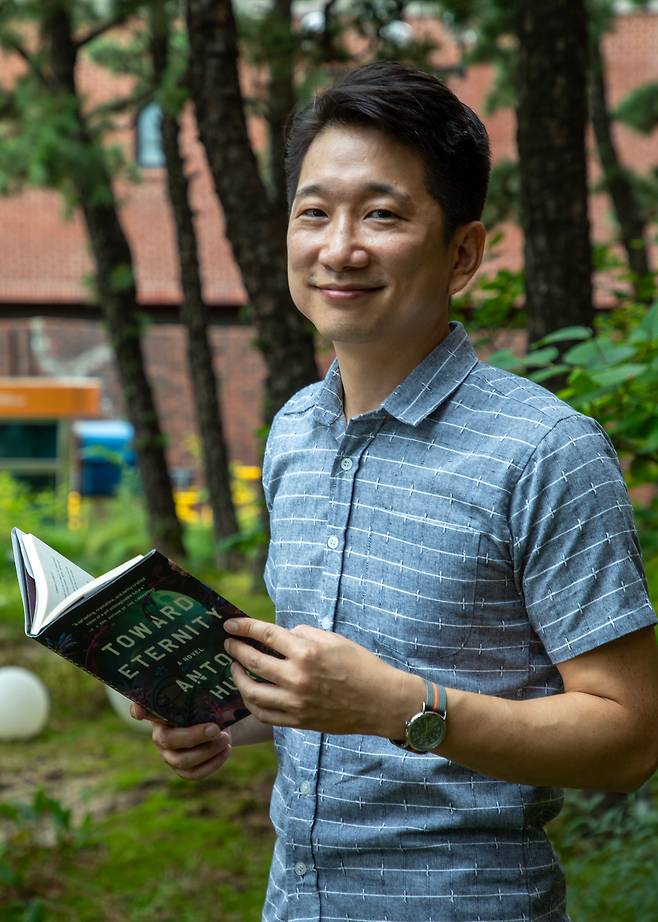
Anton Hur, 43, exuded confidence when he spoke of his job as a translator when the Chosunilbo recently met him in Gwanghwamun, Seoul. Some might describe him as a little arrogant. But given all he has achieved in just a few years, it would have seemed out of place for him to act modest.
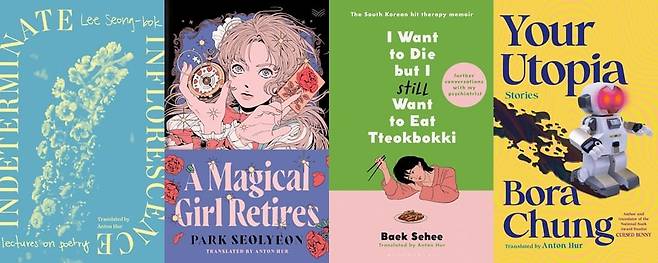
In 2022, Hur made a significant mark in the literary world with his translations of Chung Bora’s Cursed Bunny and Park Sang-young’s Love in the Big City, both of which were longlisted for the International Booker Prize. This was a groundbreaking moment, as it was the first time two Korean works were simultaneously nominated. Cursed Bunny went on to make the shortlist and gained global attention after being shortlisted for the National Book Award for Translated Literature the previous year. This year, Hur translated Lee Seong-bok’s collection of aphorisms, Indeterminate Inflorescence, which has now been shortlisted for the National Book Critics Circle’s Gregg Barrios Book in Translation Prize, putting Hur in the running for yet another prestigious award.
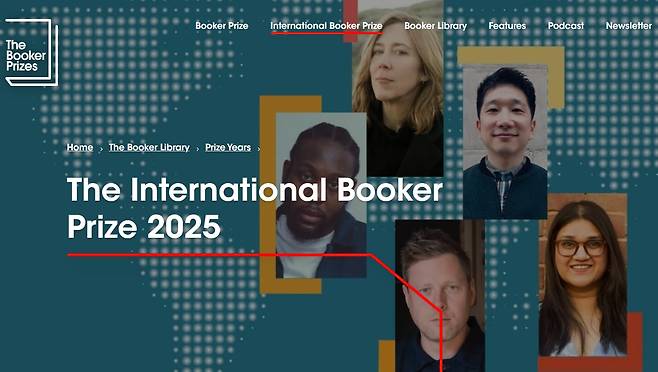
Just last month, Hur achieved another milestone by becoming the first Korean appointed as a judge for the International Booker Prize. When asked about this new role, he replied, “I can’t tell you because it’s confidential,” adding, “I have to report this interview to the committee as well.” In addition, he signed a contract to translate Lee Seong-bok’s poetry collection That Summer’s End with Alfred A. Knopf, a renowned American publisher with a century-long history. Scheduled for release in 2026, this will be Knopf’s first publication of Korean literature since Shin Kyung-sook’s Please Look After Mom in 2011, ending a 15-year gap.
But Hur’s talents extend beyond translation. He recently published his own sci-fi novel, Toward Eternity, written in English and released by HarperCollins, one of the “Big Five” U.S. publishers. The New York Times even featured him in an article titled “They Translated the Books of Others. Now They’re Writing Their Own,” highlighting his dual role as both a translator and a writer.
Hur is deeply passionate about Korean literature, and his love for reading has evolved into a careful selection of books to translate. He often pitches these books directly to English-speaking publishers. When asked about how he chooses projects, he explained, “I don’t really have a selection process. It’s like the book finds me.” Although he jokingly complains that 80% of his job involves writing translation proposals, it’s clear he takes great pride in his work.
Born in Stockholm, Sweden, and having lived in various countries like Hong Kong, Ethiopia, and Thailand due to his father’s overseas assignments, Hur has a unique perspective shaped by diverse experiences. He seems to have a knack for identifying books that will resonate with English-speaking audiences. His translation of A Magic Girl Retires by Park Seolyeon was so successful that Judith Curr, President and Publisher of HarperOne Group (a subsidiary of HarperCollins), personally thanked him during a visit to their headquarters, saying, “Park Seolyeon’s book is selling really well, thank you,” which pleasantly surprised Hur.
Hur also shows a sharp business acumen, effectively leveraging his international network. About six or seven years ago, he decided to translate Lee Seong-bok’s Indeterminate Inflorescence and applied for a grant from the Literature Translation Institute of Korea but was turned down for “lack of marketability.” However, in 2020, he presented a sample translation of the book at a workshop for international translators, where it was met with great enthusiasm, convincing him of its potential. The book was eventually published by Sublunary Editions, a small independent press in Seattle, and has gone into its sixth printing, selling thousands of copies. In the U.S., where the poetry market is even smaller than in Korea, this success was nothing short of a miracle. Penguin Random House later acquired the rights, and a hardcover edition is set to be released this fall.
Capitalizing on this success, Hur approached Knopf with Lee Seong-bok’s work, pitching it by saying, “Don’t you want to achieve success like Indeterminate Inflorescence?” Hur observed, “Lee Seong-bok’s poems, with their tangible quality and strong Zen Buddhist and abstract imagery, translate well into English.” He added, “Some authors’ styles translate so seamlessly into English that it’s almost like the English version could be considered the original. For example, Park Sang-young’s works have that quality.”
Hur’s debut novel will also soon be translated and published in Korea. Novelist Chung Bora has offered to translate it into Korean, creating a unique partnership where they translate each other’s works. “She’s a fascinating person. My novel has a lot of poetry, and her first reaction was, ‘This is interesting,’ but then she said, ‘But I really don’t like poetry.’”
All these achievements have come in just seven years of his career as a literary translator. Hur, who graduated from Korea University School of Law under parental pressure and even ran away from home to avoid taking the bar exam, has clearly found his calling. Given his success, his parents likely have little left to say to their accomplished son. “What could they say to a guy in his 40s? No parent can win against their child.”
Copyright © 조선일보. 무단전재 및 재배포 금지.