[Michelin Stars in Seoul] ⑪ L’Amitié, pioneering French cuisine for over 2 decades
이 글자크기로 변경됩니다.
(예시) 가장 빠른 뉴스가 있고 다양한 정보, 쌍방향 소통이 숨쉬는 다음뉴스를 만나보세요. 다음뉴스는 국내외 주요이슈와 실시간 속보, 문화생활 및 다양한 분야의 뉴스를 입체적으로 전달하고 있습니다.
Traveling to foreign lands can be an exciting and exhilarating experience for all of us. However, what truly makes these moments unforgettable is the pleasure of indulging in exceptional cuisine. Seoul, the capital city of South Korea, is now gaining recognition as one of the world’s premier travel destinations, beyond Asia. K-food, which stands for Korean cuisine, is also rising in popularity, aligned with K-pop and K-culture. ChosunBiz aims to introduce Michelin-starred restaurants in Seoul that offer a modern twist on traditional Korean cuisine. [Editor’s note]
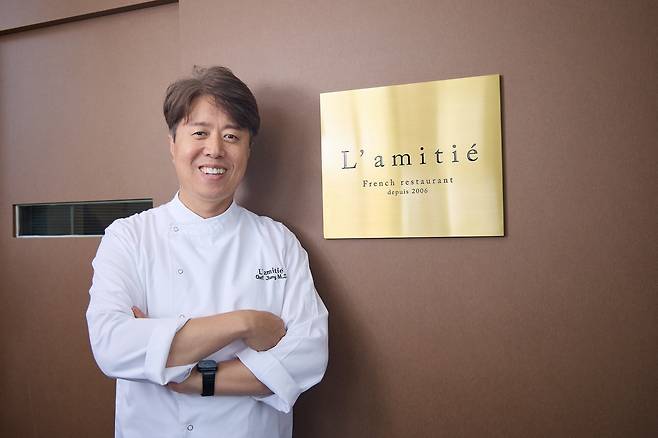
In the fine dining industry, where surviving even three years is a challenge, L’Amitié has maintained its reputation for over 20 years under the leadership of Chef Jang Myoung-sik.
The name L’Amitié means “friendship” in French, and this spirit of camaraderie is at the heart of Chef Jang’s philosophy.
Jang wants his restaurant to feel like an old friend to his customers. A good friend is someone you feel comfortable with and understand, even without words. Through his cuisine, Jang tries to build a sense of ‘friendship’ with his guests, emphasizing thoughtfulness and care.
Many people associate French fine dining with an overly luxurious atmosphere. To break this stereotype, Jang focuses on offering a “lighter” French cuisine. While staying true to traditional roots, he aims to create an environment where everyone can enjoy the meal comfortably.
The ingredients he uses are also relatively “light”. A course soley composed of meats can be overwhelming, so he incorporates exquisite yet digestible ingredients like king crab, abalone, lobster, and butterfish. Of course, Koreans’ beloved food ingredients like lamb or tenderloin are also included.
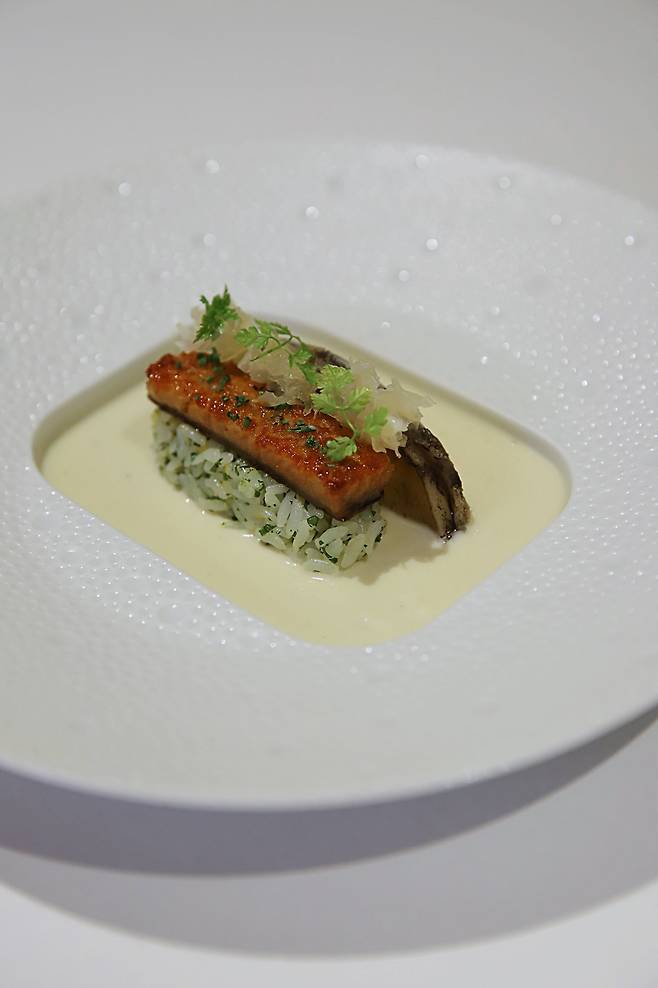
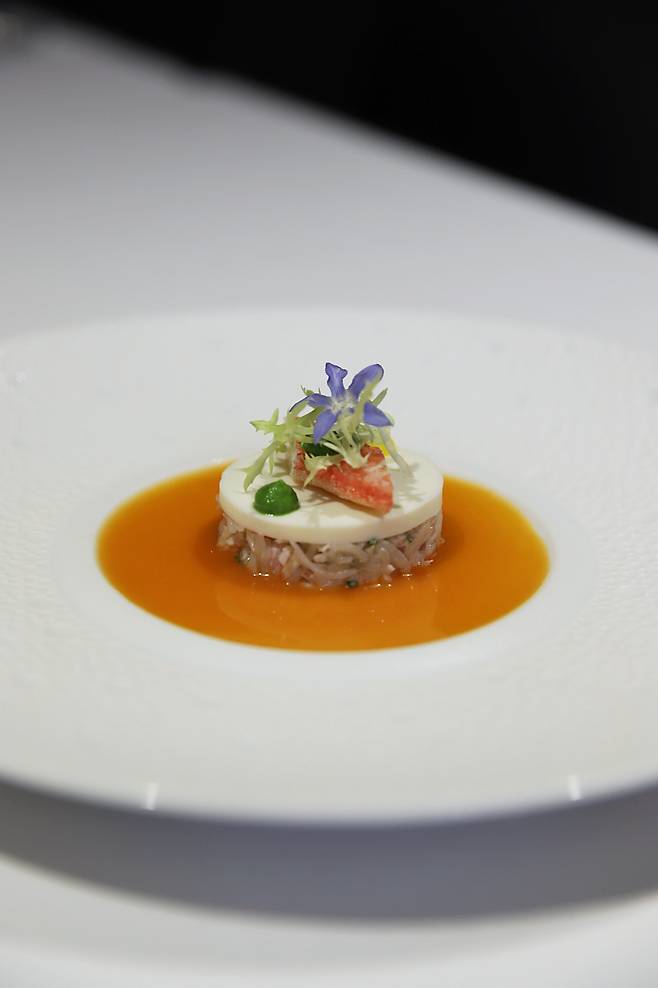
For this summer’s course, L’Amitié proudly presents dishes featuring abalone, eel, and a crab rillettes with cauliflower.
The abalone and eel, crafted in L’Amitié's unique style, are incredibly tender, reminiscent of a comforting eel rice bowl. The dish features fluffy steamed eel over well-cooked rice, enhanced with truffle paste and olive oil. The fragrant notes of lemon and parsley add a refreshing touch to the rich flavors. The crab dish includes well-seasoned crab meat mixed with shallots and chives, topped with a creamy cauliflower puree in a jelly form. Accompanied by tomatoes and sauces, the delicate seafood flavors are balanced and enriched.
The temperature of the food is another detail Jang meticulously manages. He believes the warmth of a meal should convey the same warmth you feel from a friendly hug or handshake after a long time. This is reflected in the restaurant’s course, where all dishes are served warm after the amuse-bouche and appetizers. To maintain this temperature, the kitchen’s layout is optimized so that dishes reach the guest’s table within 20 seconds.
Jang hopes to be remembered as a good friend. He strives to be genuine because without trust, any relationship falters. He wishes for L’Amitié to be a place that comes to mind easily, even when one closes their eyes, much like a cherished old friend.
―Could you briefly introduce yourself?
“After studying cooking at college in Gyeongju, South Korea, I started my culinary career at Chosun Hotel. After working there for 11 years, I took over L’Amitié in 2006 and have been running it ever since.”
―Please introduce L’Amitié.
“L’Amitié is a place that serves French cuisine. While we stick to traditional French methods, I’ve added my own personal touch. However, when it comes to sauces, I insist on traditional methods. Just as Korean cuisine has its own sophisticated dishes, French cuisine also has various types, ranging from casual bistros to boutique dining. L’Amitié can be considered a high-end dining experience.”
―What is the charm of French cuisine?
“French cuisine is very creative, featuring rare ingredients and diverse cooking techniques. However, the most attractive aspect is that French food is quite ‘scientific.’ You rarely see obese people in France. The courses, from appetizers to soups, fish, shellfish, and meat, are balanced with carbohydrates, proteins, and sugars. Interestingly, while many Koreans avoid desserts for health reasons, many French people always include dessert after a meal. Despite this, they don’t gain weight. It turns out that the sugars in desserts aid digestion. This ‘sugar paradox’ is one of the reasons I’m so fascinated by French cuisine.”
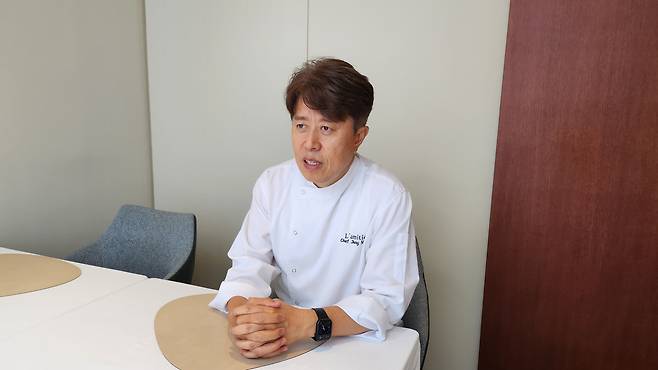
―How would you describe the French cuisine at L’Amitié?
“While we strive to present authentic French cuisine, we’ve made slight adjustments to suit Korean tastes. After all, we are in Korea, and our main customers are Korean. Therefore, we offer a lighter French cuisine. Instead of focusing mainly on meats, which can feel heavy, we incorporate seafood and serve more warm dishes than cold ones. Koreans are known for their love of soups, and they enjoy the comforting feeling of warm broth. In our course menu, all but two dishes are served warm.”
―Why do you insist on serving warm dishes?
“L’Amitié means ‘friendship.’ To express friendship, emotional warmth is important, but so is the physical warmth that comes from personal touch. Besides the service you can feel in your heart, I want to convey this warmth through the food.”
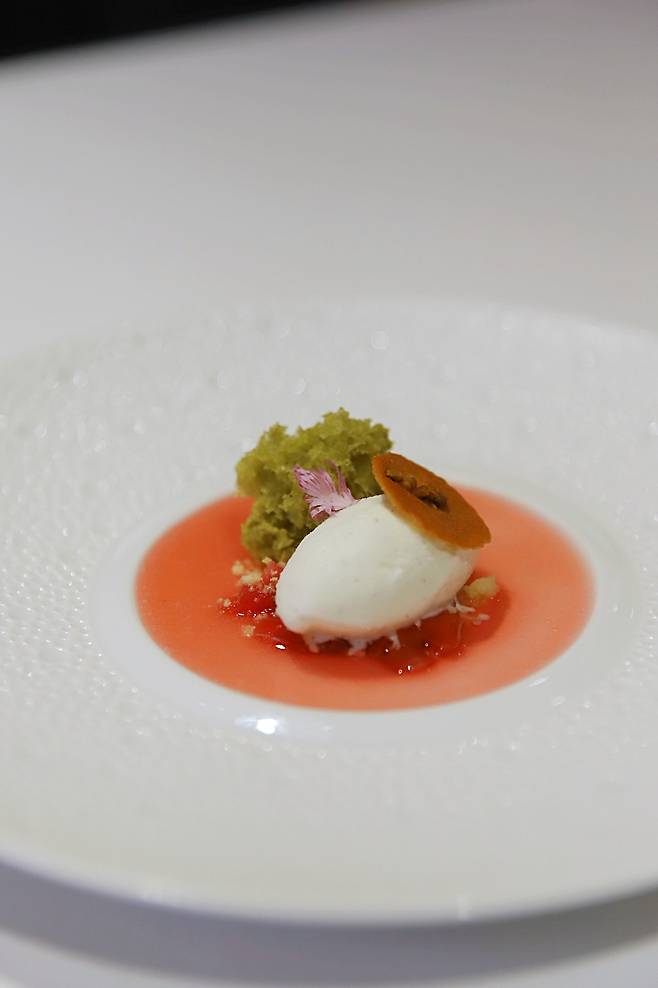
―Can you explain this season’s course?
“For the summer season, we’ve composed a menu that can be enjoyed more lightly. It’s a time when people often lose their appetite due to the heat, so we’ve included many nourishing ingredients. Our course features Korean favorites such as eel, abalone, and butterfish. The amuse-bouche includes chamoe (oriental melon), followed by fragrant pumpkin flower fritters filled with shrimp mousse, and dishes like lobster, abalone, and eel that capture the essence of summer.”
―What’s your favorite ingredient at the moment?
“Potatoes and onions. They are the most common ingredients but also the most versatile. They’re always in the kitchen like close friends, yet they offer new experiences. The transformation of these two ingredients is endless. Onions can harmonize with any dish, and potatoes are delicious whether steamed, baked, or fried. These two ingredients allow me to express everything I want through my food; they are like good friends who sometimes accept my complaints and whims (laughs).”
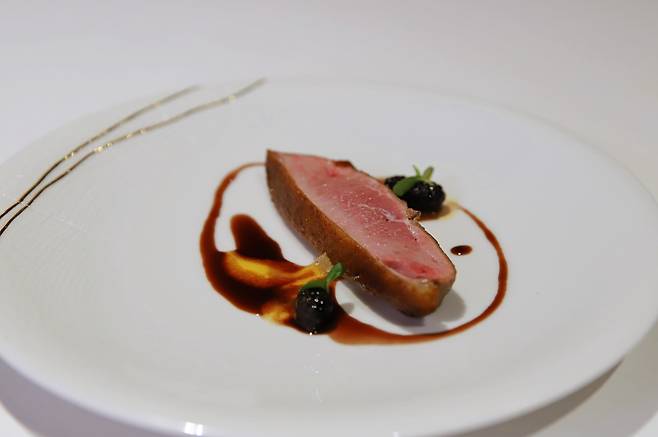
―What do you think makes a good dish?
“A dish made with care. When care is involved, the way you handle ingredients and present the dish to the guest changes. Imagine a mother making soybean paste stew. Instead of just using plain water, she painstakingly brews anchovies and adds various ingredients like pumpkin, potatoes, onions, and tofu.”
―How do you want to be remembered as a chef?
“I want to adhere to the principles of integrity in all aspects of my work. For example, sanitation is a fundamental quality that chefs must maintain. However, since the hygiene of a kitchen isn’t visible to guests, it’s easy to overlook. Maintaining these unseen aspects rigorously is honesty. Chefs wear white coats for a reason; any dirt shows immediately.”
―Lastly, do you have any words for our readers?
“I appreciate that people think of L’Amitié as a good friend, but I hope that the relationships among the people who visit us become even stronger through our restaurant. If, when you close your eyes, you recall not only L’Amitié's food but also the good memories with your companions, I couldn’t ask for more.”
Copyright © 조선일보. 무단전재 및 재배포 금지.
- 올해도 서하마가 달군 서울의 봄… 하프 박경민·김예다은, 10㎞ 백지훈·노유연 우승
- 동료 샷에 맞아 실명... 캐디 과실치상 벌금 400만원
- 이영표 “한국 축구 위해 후배들 힘내주길”... ‘서하마’ 모인 축구인들
- 李, 백악관 기자단 행사 총격 사건에 “민주주의 근간 훼손하는 중대한 위협”
- 박형준 부산시장 후보, 명예선대위원장에 김문수 전 대선 후보
- 15개월 만에 나온 ‘딥시크-V4′, 공개 평가서 10위... 블룸버그 “美, 안도의 한숨”
- 문희경 “6·25 참전용사 아버지, 편히 쉬시길” 부친상
- 신동빈 회장, 베트남 하노이에서 올해 현장경영 시작
- 스페이스X 자금을 쌈짓돈처럼 쓴 머스크...NYT 보도에, “NYT는 과거의 유물” 비아냥
- 직장인 35% “노동절 유급휴가 없다”