[Korea Beyond Korea] ‘More cross-border exchanges among academics necessary’
전체 맥락을 이해하기 위해서는 본문 보기를 권장합니다.
"So in Europe, a greater share of academics studying Korea are in the fields of humanities like folklore, anthropology and art, compared to in the US where more are in social sciences."
As for the popularity of "pseudohistory," distortions or misrepresentations of the historical record motivated by a political agenda, in Korea, Ahn said he thinks that is something seen in every country, and is rather a "negative effect of historical revisionists."
이 글자크기로 변경됩니다.
(예시) 가장 빠른 뉴스가 있고 다양한 정보, 쌍방향 소통이 숨쉬는 다음뉴스를 만나보세요. 다음뉴스는 국내외 주요이슈와 실시간 속보, 문화생활 및 다양한 분야의 뉴스를 입체적으로 전달하고 있습니다.
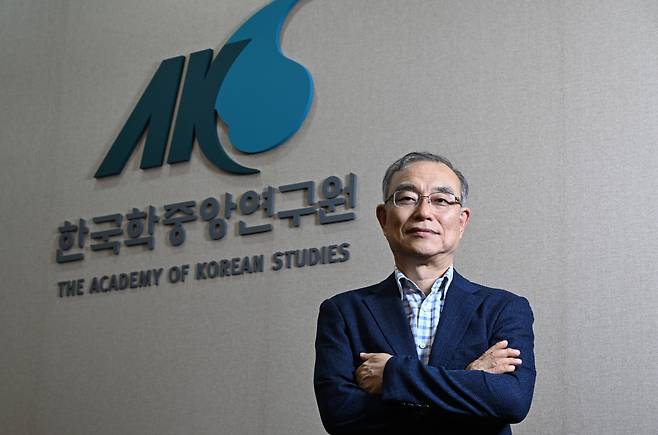
Nestled in the foothills of Seongnam, just southeast of Seoul, the Academy of Korean Studies has researched Korean culture and traditions, and fostered scholars of Korean studies from around the world since 1978.
The AKS also supports research by Korean studies academics from overseas, holds international academic seminars and publishes journals in English. But with the recent growth of Korean studies abroad, the time has come to take the academy’s international exchanges to the next level, according to its president.
“We need to expand exchanges between scholars of Korean studies in Korea and abroad,” Ahn Byung-woo, president of the AKS, said in an interview with The Korea Herald.
The Graduate School of Korean Studies under the AKS, which has 54 professors, sought ways to exchange students as well as professors with overseas graduate schools to give lectures and build scholarly networks, but they fell through due to administrative and financial problems.
Thanks to the global appeal of Korean popular culture and the country’s inspiring success story, an increasing number of college students worldwide are choosing to learn the Korean language and about Korea. But many fields such as Korean history still lack professors and courses abroad.
“Our professors should go to overseas universities to teach and conduct research for a year or two, and professors abroad should come here to do the same. We should also exchange graduate students so they can build networks with those who share research interests,” Ahn said.
As a historian specializing in the Goryeo period (918-1392), he agrees that related institutions should work towards creating faculty positions abroad for ancient and medieval Korean history, which are currently non-existent.
“Korean studies in Europe developed from the late 19th century, so there has been great interest there in Korea’s pre-modern times. But Americans only started getting interested in Korea after the Korean War (1950-53), and they were mostly interested in its politics, society and economy,” he said.
“So in Europe, a greater share of academics studying Korea are in the fields of humanities like folklore, anthropology and art, compared to in the US where more are in social sciences.”
One of the reasons Ahn believes greater international scholarly exchanges are necessary is because it has been difficult to carry out joint research or joint publications among those in Korea and abroad due to differences in academic perspectives, approaches, frameworks and styles of academic writing.
“While Korean history scholars educated in Korea, for example, closely read up on the latest research by Korean historians, and try to utilize it, many non-Korean scholars of Korean history, even if they have studied here, refer to different books,” he said.
“It is important to create more opportunities for both to communicate and keep close tabs on each other’s research trends and analyze them.”
He mentioned that once the “Cambridge History of Korea” series, to be published by Cambridge University Press, is out, it will be given much attention by those teaching Korean history abroad. The first volume of the series will cover Korea’s ancient history, the second Goryeo, the third Joseon and the last its modern history.
As a good example of academic cooperation, Ahn referred to how archaeologists in South and North Korea, Japan and China have a long history of working closely together.
“Archaeology is a bit different from history because they deal with remains and relics. Japan felt the strongest need for joint research as their ancient culture was influenced by that of China and the Korean Peninsula,” he said, mentioning how Japan invited archaeologists and historians from the Koreas and China in 1972 to examine the ancient murals of the Takamatsuzuka Tomb in Japan’s Nara prefecture. An academic society of historians from the four countries, including North Korea, was also organized then to hold annual symposiums.
Ahn himself participated in a joint inter-Korean excavation of Manwoldae, the site of the main palace of the Goryeo Dynasty, in Gaeseong, North Korea, which began in 2007.
The two Koreas’ last joint dig took place in Gaeseong in 2018, the year inter-Korean relations thawed with North Korean leader Kim Jong-un’s sister’s visit to the South’s Pyeongchang for the Winter Olympic Games.
As for the popularity of “pseudohistory,” distortions or misrepresentations of the historical record motivated by a political agenda, in Korea, Ahn said he thinks that is something seen in every country, and is rather a “negative effect of historical revisionists.”
“Historical issues cannot be unrelated to present-day politics. But history is a science, which means it has to be based on evidence,” he said.
“In Korea, the political sector often wields too much power. Primarily, historical issues should be left for historians to judge, and their judgment as experts should be respected.”
“Korean Studies Beyond Korea” explores the current landscape of Korean studies through interviews, in-depth analyses and on-the-ground stories told from diverse world areas. Funded by the Korea Press Foundation, this series will delve into the challenges and opportunities facing the field as Korea's rise as a cultural powerhouse has drawn interest from scholars, researchers and leaders from around the globe. – Ed.
By Kim So-hyun(sophie@heraldcorp.com)
Copyright © 코리아헤럴드. 무단전재 및 재배포 금지.