Wedding bells play the blues for cash-strapped friends, relatives
전체 맥락을 이해하기 위해서는 본문 보기를 권장합니다.
"The past few months have been nothing but struggling to pay congratulatory money," says Jang. "I even had to borrow money from my parents to go to a wedding."
"I'm afraid a wedding invitation may seem like I'm asking for money," said Ms. Park, who is getting married next month. "But at the same time, I cannot turn down the money because the wedding meal costs 70,000 - 80,000 won per guest."
이 글자크기로 변경됩니다.
(예시) 가장 빠른 뉴스가 있고 다양한 정보, 쌍방향 소통이 숨쉬는 다음뉴스를 만나보세요. 다음뉴스는 국내외 주요이슈와 실시간 속보, 문화생활 및 다양한 분야의 뉴스를 입체적으로 전달하고 있습니다.
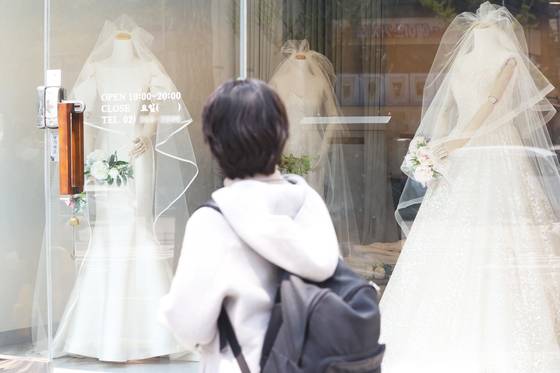
With the end of Covid-19 social distancing restrictions, one part of life that has roared back to normal is weddings. Couples forced to delay tying the knot are now rushing to do so.
That means lots of white envelopes stuffed with cash — and friends and relatives are feeling the pinch.
“After social distancing rules were lifted, I’ve been going to weddings every other week," sighs Mr. Jang, who just entered the workplace. "My salary is low, prices are rising and living expenses are tight.”
At Korean weddings, it's customary for guests to give “congratulatory money” in an envelope. The money helps pay for the reception and goes as a gift to the couple. The amount varies depending on social status and relationship to the newlyweds. For a close friend or colleague, you may give over 300,000 won ($233). Even those who can't make it to the wedding transfer money to the newlyweds' account or ask a friend to carry their envelopes.
But after the Covid-19 pandemic, some people are in parlous financial shape, with savings running low and cost of living running very high in these inflationary times.
"When I receive a wedding invitation, I don't think, 'Oh, how nice," but rather, 'I'm going to run out of money,'" says Mr. Kim, who just landed his first job. "It's sad that I can't just welcome the news of a marriage because of my financial situation."
The pandemic took a toll on young adults' pocketbooks. Many invested their savings in stocks and cryptocurrency, which have plummeted.
“The congratulatory money cost me an arm and a leg," says Kim. "There’s been a surge of weddings after the pandemic. My salary stayed the same and coins have fallen 70 percent, but prices have gone up. I have to pay at least 100,000 won for every wedding.”
“The past few months have been nothing but struggling to pay congratulatory money,” says Jang. "I even had to borrow money from my parents to go to a wedding."
Inflation has even affected congratulatory money amounts. An amount that would have been acceptable a couple of years ago is now considered stingy.
“100,000 won has become the minimum,” says Mr. Cho, 27. "Going to weddings has taken a toll on my bank account."
“I skip coffee to save, but I have to go to weddings,” says Mr. Lee, 33. "I know that weddings cost couples more now, with prices of flowers and food increasing, so I’m worried that even if I give 100,000 won, it will be considered cheap by my friend.
A “no-show culture” is emerging, in which people transfer money to the newlyweds’ bank account without attending the ceremony itself, and get away with a smaller amount.
“I send 50,000 won if they’re an acquaintance,” says Choi. "I feel like I have to give at least 100,000 won if I attend the reception and eat there."
Couples are feeling the strain too.
“I’m afraid a wedding invitation may seem like I’m asking for money," said Ms. Park, who is getting married next month. "But at the same time, I cannot turn down the money because the wedding meal costs 70,000 - 80,000 won per guest.”
“Getting married comes with more stress than happiness," says Mr. Seong, who tied the knot recently. "Some friendships have been ruined because of the congratulatory money.”
The awkwardness is only going to increase with the prices of all things matrimonial.
“Meals at wedding receptions outside hotels are usually 40,000 to 70,000 won, but that is likely to increase due to high prices,” said a manager of a wedding hall in downtown Seoul.
“In this era of high prices, the damage is concentrated on the younger generation and people with low incomes," says Kim Tae-gi, economics professor emeritus at Dankook University.
"Because they can't afford the present, weddings come as a burden to them.”
“Congratulatory money used to be a custom in which people gave to genuinely congratulate the newlyweds," says Yoon Sang-chul, a sociology professor at Hanshin University. "Now it’s a huge burden for many. Yet, many still believe congratulatory money defines social reputation and mutually compensates one another, which is why this custom will not disappear.”
BY YANG SU-MIN [kjdnational@joongang.co.kr]
Copyright © 코리아중앙데일리. 무단전재 및 재배포 금지.
- HYBE not required to disclose BTS 'hiatus,' Korea Exchange says
- No going back to normal for Korea's bathhouses, jjimjilbang
- BTS's V, Blackpink's Lisa, actor Park Bo-gum attend Paris Fashion Week's Celine show
- Son Heung-min mural painted on Tottenham building
- Samsung Electronics set to manufacture 3-nanometer chips
- Cha Eun-woo to tour Asia for fan meet-and-greet
- Son Ye-jin and Hyun Bin are expecting a baby
- After 512 episodes, Yumi and her cells say their final goodbye
- SK bioscience's Covid-19 vaccine clears major hurdle
- Actor Jung Eun-hye shows disability can't stop talent