KIST scientists develop memristor-based sensory receptor for humanoid robots
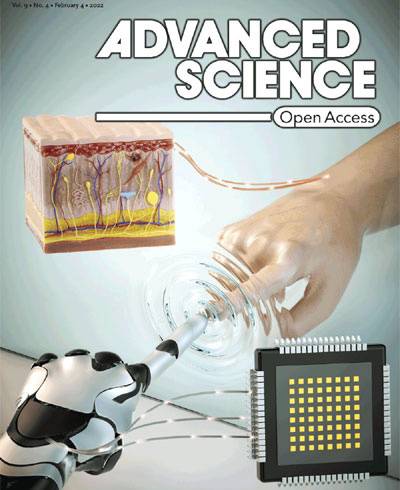
Korea Institute of Science and Technology (KIST) said on Sunday its research team led by Dr. Kang Chong-yun and Dr. Yoon Jung-ho has demonstrated the electronic receptor to exhibit a selective response to innocuous stimuli with the adaptive operation. Under noxious stimuli, the output current is not generated for the adaptive receptor, whereas the nociceptor is triggered with the maladaptive operation, which means it feels pain like humans do.
This is the world's first development of a selective response device whose adaptation/maladaptation depends on the size of the stimulus. The research findings were published as a cover story in the latest edition of Advanced Science.
The research team believed that existing research to imitate human signals with electronic devices is focused on mimicking some biological properties such as neurons and synapses and started research to find out how the human body interprets and accepts changes in the external environment and how to implement this as an electronic device.
The research team developed a special device by utilizing the properties of Ag particles that easily move in response to electrical stimulation. The Ag is suitable for implementing a volatile threshold switching device because of its low activation energy for diffusion.
When two devices containing a small and large amount of Ag particles are connected in parallel, the device with a large amount of Ag particles does not respond to a weak stimulus. A weak filament is formed in the device with a small amount of Ag particles, but the filament breaks soon due to heat and the signal stops. This is a process of adaptation to weak stimuli.
Under a strong stimulus, the device containing a small amount of Ag particles is heated and disappears in a short time that humans cannot perceive. Filaments in the device containing a large amount of Ag particles are not easily broken and continue to generate signals. In this case, the device does not adapt to the stimulus to feel the pain.
KIST said this new artificial receptor potentially serves as the interface between external information and the internal nervous system, incorporable into all kinds of biomimetic sensory systems such as vision, tactile, auditory, gustatory, and olfactory, as well as the sensory system of humanoid robots.
[¨Ï Maeil Business Newspaper & mk.co.kr, All rights reserved]
Copyright © 매일경제 & mk.co.kr. 무단 전재, 재배포 및 AI학습 이용 금지
- Jeju Air to bump up air cargo delivery - Pulse by Maeil Business News Korea
- Discovery Asset and CEO accused of favoritism and fraud likely to be suspended - Pulse by Maeil Business News Korea
- Korean public funds perform nicely in ’21 investment through bigger overseas weight - Pulse by Maeil Business News Korea
- Retailers are concerned about a fourth-wave pandemic and rising living costs - Pulse by Maeil Business News Korea
- Newly-established enterprises surge in January - Pulse by Maeil Business News Korea
- 강경준, 상간남 피소…사랑꾼 이미지 타격 [MK픽] - 스타투데이
- AI가 실시간으로 가격도 바꾼다…아마존·우버 성공 뒤엔 ‘다이내믹 프라이싱’- 매경ECONOMY
- 서예지, 12월 29일 데뷔 11년 만에 첫 단독 팬미팅 개최 [공식] - MK스포츠
- 이찬원, 이태원 참사에 "노래 못해요" 했다가 봉변 당했다 - 스타투데이
- 양희은·양희경 자매, 오늘(4일) 모친상 - 스타투데이