Paek Ki-wan and His Unwavering March Toward Democracy and Unification: The Mission He Left Behind [Editorial]
이 글자크기로 변경됩니다.
(예시) 가장 빠른 뉴스가 있고 다양한 정보, 쌍방향 소통이 숨쉬는 다음뉴스를 만나보세요. 다음뉴스는 국내외 주요이슈와 실시간 속보, 문화생활 및 다양한 분야의 뉴스를 입체적으로 전달하고 있습니다.
[경향신문]
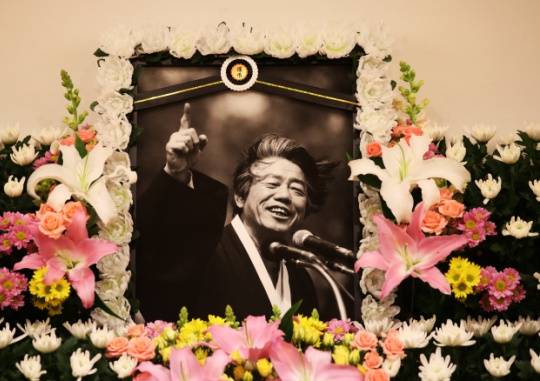
The collection of essays, Holding a Purple Breast-Tie in Your Mouth and Waving a Jade Green Skirt, published by Paek Ki-wan in his forties, was a wake up call to the young adults and college students living under a military regime in the early 1980s. In the form of a letter to his daughter, Paek roared, “Shatter the idol of an eldest son’s wife who increases the property of her father-in-law.” He urged men to “agonize over and struggle, alone or in groups, to right the dark world.” What Paek wanted for the young people was a peaceful unification by our own hands and a society, where working people, such as drivers and manual workers, were respected, but this was his personal goal as well.
Born at the foot of Mount Kuwol in Unnyul, Hwanghae Province, Paek followed his father to Seoul after national liberation on August 15, 1945. He opened his eyes to the reality of a divided nation when he met Baekbeom Kim Gu at Gyeonggyojang House. In 1967, he established an institute dedicated to the philosophy of Kim Gu with Chang Chun-ha and studied the history and philosophies of our people. The institute was renamed the Institute for Unification Studies in the 1980s and Paek began promoting unification. He was tortured and imprisoned during the dictatorship and every time law enforcement officials asked his identity, he answered, “I am a seeker of unification.”
Paek thought unification was the completion of democracy and peace in terms of our people, so he actively took part in the fight against anti-unification and anti-democracy movements. He never failed to show up in pro-democracy demonstrations, such as the struggle against the treaty with Japan, the rally against the constitutional amendment allowing a third presidential term, the movement to abolish the Yusin regime, and the Gwangju Resettlement Town incident. After a constitutional amendment in the late 1980s that allowed the people to directly elect the president, Paek was one of the presidential candidates supported by the people. Since then he has fought for workers, farmers, and the poor. Paek stood in solidarity with the struggles by workers and the people, such as the Yongsan disaster, the struggle to reinstate laid-off workers at Ssangyong Motor Company and Cort-Cortek, and recently, he supported the enactment of a bill on the punishment of companies for serious accidents.
Paek kept away from public office throughout his life. He not once sat on any of the many government committees. Paek was the person who first coined the word, jaeya (在野), a Korean word that refers to a political power lying outside the institution. There were many jaeya figures, but none remained outside the political institution all their lives. Paek was able to continue his march toward democracy and unification, because he was never tainted by money or power.
On February 15, Paek Ki-wan passed away. If a person coming means that his past, present and future is coming, a person passing means that his entire life has gone. Paek’s absence is an incomparable loss. But that does not mean we should part with the courage and passion he showed in his fight against injustice. Paek stressed the philosophy of nonamegi or sharing: people working together and all living prosperously in a unified world. But the Korean Peninsula remains divided, and labor is still not respected. Unification and social democracy, which Paek failed to achieve, remains as our mission.
Copyright © 경향신문. 무단전재 및 재배포 금지.
- [속보]내년 최저임금 시간당 1만700원 최종 결정···올해보다 3.7% 오른다
- “평생 첫 자가” 이 대통령 분당 아파트 팔렸다···이 “나는 이제 집 없다”
- 한밤 중의 부탄가스 폭발에 ‘아파트 쑥대밭’···주민 1명 전신화상
- 조희대 대법원장 경호차량 정읍서 교통사고···3명 경상
- [시스루피플] 7살에 소설 쓴 ‘문학 천재’, 표절로 추락···불공정 아이콘 된 장팡저우와 들끓
- 물폭탄 남기고 비껴간 태풍···15일까지 최대 120㎜ 쏟아붓고 다시 폭염
- ‘이동재 기자 명예훼손’ 김어준, 1심 벌금 2000만원···법원 “여론 왜곡 측면서 죄질 불량”
- ‘194cm 거구의 노르웨이 베이비걸’···월드컵 홀린 홀란, 머리끈에 연어까지 완판시킬 판[이윤
- 35억 들인 세계 최대 CT, 국중박의 ‘신문물’···가부좌 튼 황금불상이 검사대에 누웠다
- 홍준표 “윤석열 여론조사 징역형 정확한 판단…오세훈도 빠져나가기 어려울 것”