[News Focus] De facto jobless increases 60,000 in a month
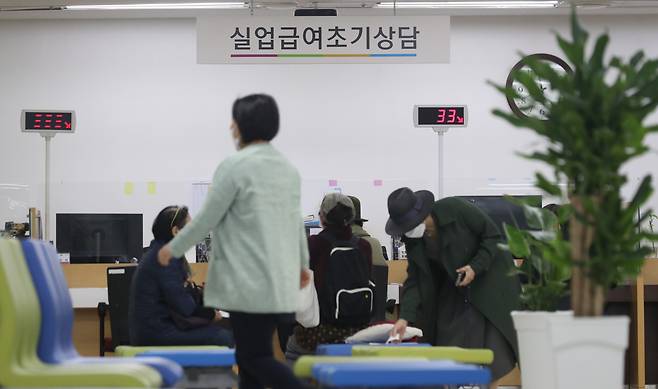
SEJONG -- The Korean government was pinning hopes on recovery in employment in the second half of the year, though the tally of the jobless increased sharply between March and May in the wake of the COVID-19 pandemic.
Though the number of “unemployed plus underemployed” showed signs of gradually falling during the summer, the monthly figure bounced back in September.
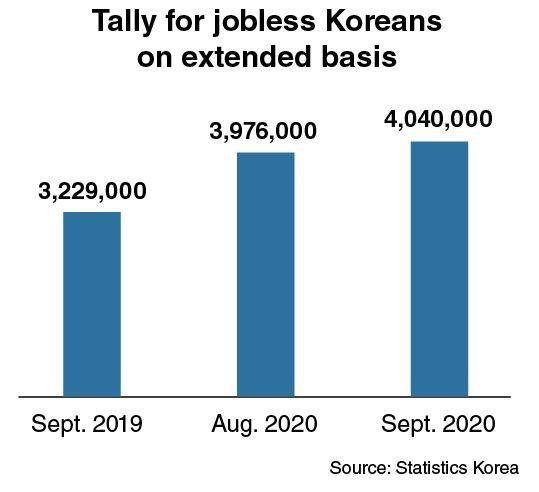
According to the Supplementary Index III for Employment, as determined by Statistics Korea, the number of “de facto unemployed (unemployed or underemployed)” came to 4.04 million in September, up 63,000 from the previous month.
Index III provides a relatively new method of calculating unemployment, counting underemployed people among the de facto unemployed. This category, also called “extended-based” jobless, includes those who work fewer than 36 hours a week and want to work more, as well as seasonal workers who are out of work for part of the year.
De facto joblessness reached 13.5 percent of the economically active population, 29.93 million. This represents a wide disparity from the nation’s official jobless rate of 3.5 percent for September, which was calculated -- in a quite conservative manner -- and published by the government.
Compared to a year earlier, the de facto jobless rate rose by 2.7 percentage points. In September 2019, the tally for the unemployed or underemployed stood at 3.22 million, which indicates a surge by 810,000 on-year basis.
Data showed that the gradient was steeper among those aged between 15-29. The de facto unemployment rate among the young age bracket posted 25.4 percent in September, compared to 21.1 percent a year earlier.
The tally for de facto youth jobless came to 1.21 million of the economically active population (4.79 million) for the corresponding bracket. The figure of unemployed plus underemployed for September 2019 was 1.03 million.
The seriousness is also seen from the monthly comparison data for the government’s payouts of unemployment benefits.
According to the Korea Employment Information Service, the balance for payouts for the jobless reached 1.19 trillion won ($1.05 billion) in September. This marked a sizable surge from a year earlier, when the figure was 498.4 billion won.
In September, people in their 50s accounted for the largest proportion of those on unemployment benefits at 25.8 percent, whereas those in their 60s comprised 22.9 percent. Next were those in their 40s with 18.7 percent, those in their 30s with 17.6 percent and those in their 20s at 14.2 percent.
Men slightly outnumbered women among benefit recipients that month, accounting for 50.7 percent of the total.
An analyst said the rapid surge in payouts was inevitable amid the novel coronavirus pandemic. But he referred to a core point that should not be glossed over, saying that payments of unemployment benefits started surging in 2018, when the nation saw self-employed people’s businesses close en masse.
The nation’s self-employed, or microbusinesses, accounted for about 25 percent of all working people.
Compared to 5 trillion won in benefit payouts in 2017, the balance shot up to 8.07 trillion won in 2019, recording a 61.4 percent climb in only two years.
By Kim Yon-se (kys@heraldcorp.com)
<ⓒKoreaHerald(www.koreaherald.com)무단전재 및 재배포 금지>
Copyright © 코리아헤럴드. 무단전재 및 재배포 금지.