S. Korea's tax income from stock trade to be doubled from last year and hit record-high
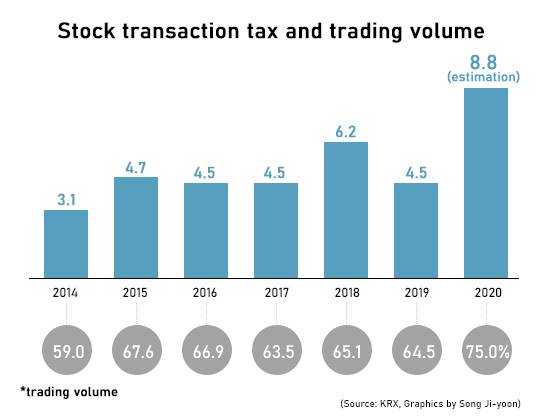
According to the Korea Exchange and National Tax Service on Tuesday, turnover at the main Kospi and secondary Kosdaq market from December 2019 to September 18 amounted to 4,030 trillion won ($3.4 trillion), with the daily tally averaging at 20.15 trillion won.
At this rate, about 4,977 trillion won in stock trade could be subject to 2020 fiscal tax bill, soaring 119.7 percent from last year.
The tax rate on average has gone down to 0.10 percent from 0.15 percent for the main Kospi and to 0.25 percent from 0.30 percent from May 30 last year. That would mean 0.18 percent would be taxed for this year’s stock trade, compared with 0.22 percent average from 2014 to 2018.
Based on the estimation, this year’s tax revenue from stock transactions would reach 8.8 trillion won, more than doubled from last year’s 4.47 trillion won and overwhelm 2018 record-high of 6.24 trillion won.
Individual and day traders have been swarming into the stock markets amid easy and cheap liquidity from record-low interest rates and scarce investment options. Retail investors were behind 288.4 trillion won, or 75 percent of total trade turnover as of Sept. 18.
The stock transaction tax rate goes down by 0.02 percentage point in 2021 and 0.08 percentage point in 2023.
[ⓒ Maeil Business Newspaper & mk.co.kr, All rights reserved]
Copyright © 매일경제 & mk.co.kr. 무단 전재, 재배포 및 AI학습 이용 금지
- S. Korea set to execute 4th extra budget of near $7 billion to fund coronavirus relief - Pulse by Maeil Business News Korea
- Samsung Biologics wins $330.8 mn CMO orders from AstraZeneca - Pulse by Maeil Business News Korea
- Korean Air to reopen flights to Osaka temporarily until October - Pulse by Maeil Business News Korea
- Kia Motors releases update in all-time favorite Sportage - Pulse by Maeil Business News Korea
- ITC to give second review on preliminary ruling over Daewoong-Medytox botox disputes - Pulse by Maeil Business News Korea
- 강경준, 상간남 피소…사랑꾼 이미지 타격 [MK픽] - 스타투데이
- AI가 실시간으로 가격도 바꾼다…아마존·우버 성공 뒤엔 ‘다이내믹 프라이싱’- 매경ECONOMY
- 서예지, 12월 29일 데뷔 11년 만에 첫 단독 팬미팅 개최 [공식] - MK스포츠
- 이찬원, 이태원 참사에 "노래 못해요" 했다가 봉변 당했다 - 스타투데이
- 양희은·양희경 자매, 오늘(4일) 모친상 - 스타투데이