National hydrogen drive creates perfect window for Korean conglomerates
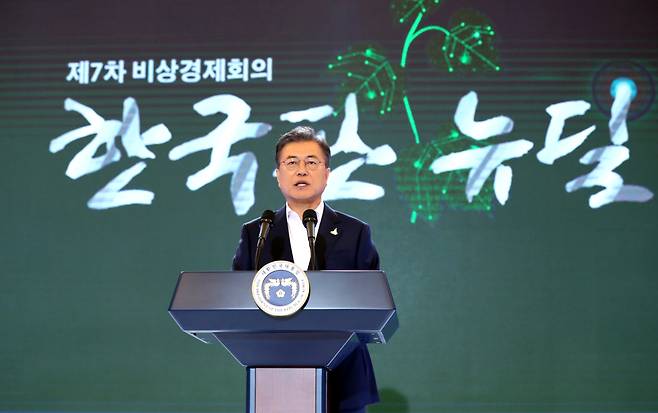
President Moon Jae-in’s push for hydrogen economy has created a perfect window for Korean conglomerates to create synergies with their affiliates and find a new growth engine in the burgeoning industry.
On Tuesday, President Moon, who aims to roll out 6.2 million hydrogen vehicles and 1,200 charging stations by 2040, held a videoconference with Hyundai Motor Group Executive Vice Chairman Chung Euisun to discuss specific plans to take the lead in the global hydrogen vehicle market and to realize a hydrogen economy here.
On July 1, the Moon administration formed the Hydrogen Economy Committee to nurture 500 companies that specialize in hydrogen by 2030 as part of its green growth initiative, the “Green New Deal.”
Leading businesses in related fields have already been making large-scale investments for the hydrogen industry.
In April, Hyosung Group, the 26th biggest conglomerate in Korea, said it would jointly build and operate the world’s largest liquid hydrogen plant with Linde Group on a 30,000-square-meter site at Hyosung’s chemicals plant in Ulsan. The facility, which will be completed by 2022, will have an annual production capacity of 13,000 metric tons of liquid hydrogen, enough for 100,000 sedans.
Liquid hydrogen is capable of shrinking to 1/800th of its original volume in a gaseous state, and is easier to store and transport.
The two companies also agreed to set up around 120 hydrogen recharging stations across the country, which will be built by joint venture between Linde Group and Hyosung Heavy Industries -- an affiliate of Hyosung Group that has two decades of expertise with high-pressure gas. After initiating compressed natural gas charging business in 2000, Hyosung Heavy started its hydrogen recharging station business in 2008. It has since built 15 recharging stations nationwide, commanding 40 percent market share.
Meanwhile Hyosung Advanced Materials, another affiliate of Hyosung Group, plans to manufacture carbon fiber, a raw material four times lighter yet 10 times stronger than steel, suitable for hydrogen tanks. When President Moon visited Hyosung Advanced Material’s plant in Jeonju, North Jeolla Province, last August, the company said it would invest 1 trillion won ($829 million) to increase the production capacity of carbon fiber from 2,000 tons to 24,000 tons.
Kolon Industries, the chemical and textile unit of Kolon Group, Korea’s 33th biggest conglomerate, is focusing on key components of hydrogen fuel cells based on its 31 years of expertise in membrane technology. Earlier this month, Kolon Industries unveiled its plan to mass-produce core components of hydrogen fuel cells including membrane humidifier, membrane electrode assembly and polymer electrolyte membrane.
After commercializing the world’s first moisture controller for hydrogen fuel cells with Hyundai Motor in 2013, it now aims to increase its global market share to 50 percent by 2025.
Korea’s No. 7 conglomerate Hanwha Group is another conglomerate looking for hydrogen opportunities. In 2018, its two affiliates Hanwha Energy and Hanwha General Chemical each invested $50 million in US hydrogen truck maker Nikola Motor for a 6.13 percent stake.
Along with the $100 million investment, which later ballooned to $750 million, Hanwha Energy and Hanwha General Chemical have secured the rights to provide electricity generated by solar power to Nikola’s charging stations and the operation rights to run them, respectively.
Taking initiative of Nikola’s hydrogen charging stations is expected to give boost to Hanwha Solutions, a newly formed corporation upon the merger of Hanwha Chemical and its wholly owned solar panel subsidiary Hanwha Q Cells and Advanced Materials in January.
Hanwha Q Cells can make solar cells and modules while Hanwha Advanced Materials can manufacture hydrogen tanks for stations or trucks. Hanwha Chemical is currently developing its own technology to use electricity to split water into hydrogen and oxygen.
By Kim Byung-wook (kbw@heraldcorp.com)
<ⓒKoreaHerald(www.koreaherald.com)무단전재 및 재배포 금지>
Copyright © 코리아헤럴드. 무단전재 및 재배포 금지.