Online Classes Instead of Rushing to Start School: Many Agree, But Reality Is Not So Adaptable [COVID-19 Outbreak]
이 글자크기로 변경됩니다.
(예시) 가장 빠른 뉴스가 있고 다양한 정보, 쌍방향 소통이 숨쉬는 다음뉴스를 만나보세요. 다음뉴스는 국내외 주요이슈와 실시간 속보, 문화생활 및 다양한 분야의 뉴스를 입체적으로 전달하고 있습니다.
[경향신문]
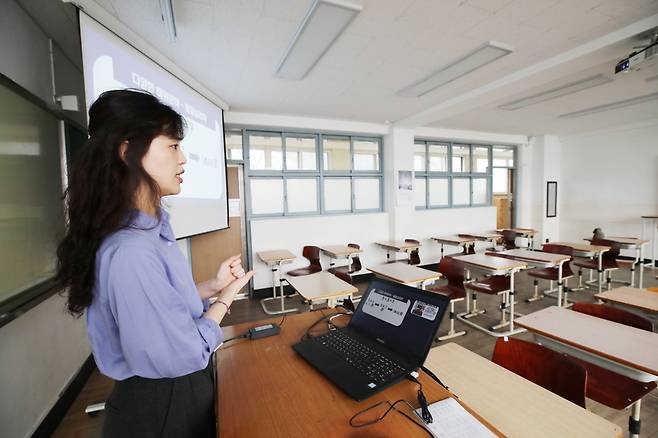
COVID-19 is refusing to die down, and experts predict the possibility of online classes replacing school for elementary, middle and high schools scheduled to begin April 6. In case COVID-19 is not contained, the Ministry of Education is reviewing measures to recognize online classes as official school days rather than further postpone the first day of school, which has already been pushed back three times. On March 26, some schools notified homes about demonstrations of online classes and began an environmental survey to see who owned what kind of smart devices.
Parents agree that online classes could be a realistic alternative to avoid any mass infection that can be triggered by hastily starting school. But the quality of online classes differ widely depending on schools and regions, and the education gap can increase for the socially vulnerable, who do not have adequate digital facilities.
The satisfaction survey on the e-Learning Site and EBS Online Classes currently in operation shows a significant disparity. A, the mother of three children said, “The youngest is in first grade. His school purchased an online English program and distributed it to all the students. His teacher gives him assignments everyday and constantly manages progress.” She further elaborated, “Meanwhile, the two older kids are in middle school. Their school doesn’t have a suitable program to fill the absence of school.” B, who has two sons, eleven and twelve years old, said, “Third to sixth graders can take online classes on the EBS elementary site, but we only have one computer at home, so we have a problem because the classes are aired at the same time.”
Education organizations are concerned because schools will have to hurry to improve the system with less than two weeks remaining until the first day of school. Jung Hyun-jin, a spokesperson for the Korean Teachers and Education Workers Union said, “Starting school online will be realistically possible when the central government builds the infrastructure, distributes a detailed manual, and provides solutions to issues like sufficient servers for when a large number of students try to log in simultaneously.”
People in the education field claim that the government policy has to be more prudent. There is a big gap in the effectiveness of online learning depending on the level of school. In the case of elementary school, the younger the students, the more likely for them to have trouble concentrating and handling the devices, so someone has to be with them throughout the class. Thus children in low-income families, children with both parents working, and children living with their grandparents are likely to face more challenges.
Seong Ok-gyu, a teacher at Insu Elementary School said, “Since the TV is more widely distributed than smart devices, it would be better to take advantage of EBS broadcasts than the internet.” Seong added, “As for the classes, it would be better to explain the contents in the textbook than to focus on solving problems, and it would be most realistic for students to post questions and assignments on an online learning board opened by their teacher.” However, when it comes to high school, schools have different elective courses so they can be restricted in using EBS shows.
Some experts argue that the government should select and distribute a stable educational software, most appropriate for the situation in South Korea, to prepare for an era of online classes. Yi Beom, an education critic said, “I personally witnessed British high schools I recently visited begin online classes five days after schools were closed. The problem is the system.” He further explained, “Whether it begins on April 6 or a month later, we can always find ourselves in a position to begin online classes, so preparation is absolutely necessary.”
Meanwhile, quarantine authorities announced they would refer to Singapore, which recently started school, when determining whether or not to start school on April 6. Singapore opened its schools as scheduled on March 23 based on a judgment that schools could be safer since children were less likely to be infected by COVID-19 than adults.
Copyright © 경향신문. 무단전재 및 재배포 금지.
- 다카이치 총리 “내일 의회 일정 있어 술 마실지 고민”···이 대통령 “제가 전화해볼까요?”
- “내일 스벅” “샌드위치 먹어야징”···국힘 충북도당·거제시장 후보, ‘탱크데이’ 논란에
- ‘빠더너스’ 문상훈은 왜 이 코미디 영화를 ‘콕’ 찍었을까
- 김성식 “스타벅스 탱크데이 행사, 정용진 회장 기획작품 아닌가…양심고백할 때”
- “식탁 위 불로초, 양파 사세요”…일일 쇼호스트 변신 송미령 장관, 평소의 10배 팔았다
- “앗 여기 아닌데” 고속도로 잘못 나가도 돈은 안 나간다···15분 내 재진입 시 기본요금 면제
- 계엄 장성들 ‘반란 혐의’ 줄입건···대통령이 ‘수괴’인 반란, 가능할까
- “머그잔 부수고 불매…” 정용진 신세계회장 사과에도 ‘탱크데이’ 뭇매
- 산소 다녀오던 가족 참변···고속도로 추돌 뒤 차량 화재로 4명 숨져
- [속보] ‘노상원에 비화폰 지급’ 김용현 전 국방장관 1심 징역 3년 선고