"Insecticide Eggs" Found in Cheolwon, Cheonan, and Naju. Use of Eggs Suspended in Schools and the Military
이 글자크기로 변경됩니다.
(예시) 가장 빠른 뉴스가 있고 다양한 정보, 쌍방향 소통이 숨쉬는 다음뉴스를 만나보세요. 다음뉴스는 국내외 주요이슈와 실시간 속보, 문화생활 및 다양한 분야의 뉴스를 입체적으로 전달하고 있습니다.
[경향신문]
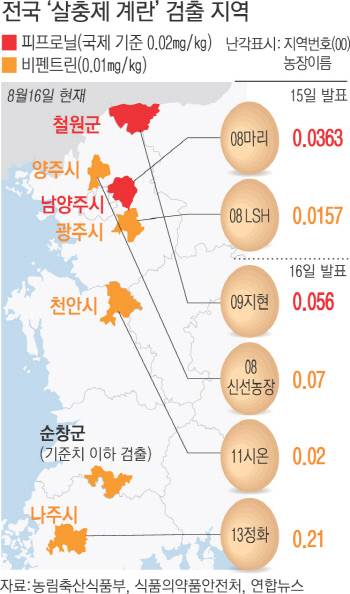
On August 16, the government confirmed that egg farms in Yangju, Gyeonggi-do; Cheolwon, Gangwon-do; Cheonan, Chungcheongnam-do; and Naju, Jeollanam-do also produced insecticide-tainted eggs. The problem of “insecticide eggs” discovered in Namyangju and Gwangju in Gyeonggi-do the previous day spread nationwide. Insecticide-tainted eggs were also discovered for the first time among products that were sold to consumers. Large supermarkets have resumed the sale of eggs, while the use of eggs has been suspended in schools and military units, confusing the consumers.
On August 16, the Ministry of Agriculture, Food and Rural Affairs announced that they detected Fipronil, an insecticide banned on chickens, in the eggs produced from an egg farm with 55,000 hens in Cheolwon after a preliminary inspection of 243 egg farms. In the case of the farm in Cheolwon, 0.056mg/kg of Fipronil was detected, much more than the international Codex standard (0.02mg/kg).
In the eggs from a farm in Naju, 0.21mg/kg of Bifenthrin, more than 21 times the allowed limit (0.01mg/kg), was detected. Eggs from a farm in Cheonan also showed 0.02mg/kg of Bifenthrin, exceeding the legal limit. This is the first time that insecticide-tainted eggs were discovered among eggs out on the market, putting the citizens into greater shock.
This day, Bifenthrin exceeding the legal limit was also detected in the eggs from a farm in Yangju, which raises some 23,000 hens. When we add the farms in Namyangju and Gwangju in Gyeonggi-do from the previous day, a total of six farms have produced insecticide-tainted eggs so far.
This day, the Ministry of Education sent out an official letter to the offices of education in cities and provinces asking the schools to refrain from using eggs until they could confirm their safety. Most offices of education nationwide, including the Seoul Metropolitan Office of Education have decided not to use eggs in school lunches for the time being. The Ministry of National Defense also announced that it would stop providing eggs in military meals. Citizens have been throwing out the eggs already purchased or have been avoiding food containing eggs. Bakeries and restaurants have taken eggs out of their products and dishes or are only providing them upon the customer‘s request.
However, egg farms that have passed the government inspection have begun distributing their products after receiving a certificate this day. The volume of shipment is 25% (11 million) the total egg distribution (43 million). Major retailers such as E-mart, Lotte Mart, and GS25 have also resumed the sale of eggs, a day after they stopped selling them. The Ministry of Food and Drug Safety asked consumers to return eggs printed with the letters “09지현 (jihyeon)” or “08신선농장 (sinseonnongjang),” which identify the producer (Jihyeon Farm in Cheolwon, Sinseon 2 Farm in Yangju), on the egg shell.
This day, President Moon Jae-in called Prime Minister Lee Nak-yeon and ordered, “The prime minister should oversee the situation and all related ministries, and take every necessary measure to specifically inform the public of the inspection results.”
Minister of Agriculture, Food and Rural Affairs Kim Young-rok said, “We decided to collect and dispose of all processed food using eggs from farms where Fipronil was detected in a meeting of the government, Cheong Wa Dae and the ruling party.” He also said, “There is also the possibility of ’old‘ hens, which lack the ability to produce eggs, being used as chicken in processed foods,” and stressed, “We will collect and dispose of all processed foods suspected of using the old chickens from egg farms where Fipronil was detected regardless of the amount.”
Copyright © 경향신문. 무단전재 및 재배포 금지.
- 31세 명문대 공학도, 왜 총을 들었나···트럼프 만찬장 총격 사건 용의자는 누구?
- 백악관 만찬 행사 시작 30분 만에 아수라장···긴박했던 ‘VIP’ 대피 순간
- ‘순방 복귀’ 하정우, 다가온 결단의 시간…평택을 조국 대항마는 이광재냐 김용남이냐
- [오토 차이나 2026]“봐도 봐도 끝이 없다”…축구장 50개 크기 공간서 펼쳐진 전기차 기술의 향연
- 29명 목숨 앗아간 제천 화재 참사 29억 위로금···우여곡절 끝에 지급
- 호르무즈 해협 폐쇄로 미국 기업만 웃는다···3~4월 에너지 수출 역대 최대
- 낚시·조개잡이 관광용 전락한 ‘인천공항 자기부상열차’···타는 승객도 없다
- 김병민 정무부시장 등 오세훈 참모들 서울시 떠난다···“본격적인 선거운동 돌입”
- “나랑 애인해도 되겠어” 20대 여성 등산객 얼어붙게 만든 노인
- “1분기 순이익 1조원” 증권사, 코스피 불장에 ‘만년 조연’ 탈피···실적 전망 금융지주도 넘