Historical manuscript reveals Joseon military capability
The National Library of Korea has disclosed a rare document showing the military capability of the Joseon era (1392-1910), Monday.
Joseon officials prepared manuscripts to complete "haeyu," the process of transferring duties to a successor.
The library's disclosed haeyu document was compiled by Yoon Bin, an army second deputy of the West North Camp in Giljumok, North Hamgyong Province, during the ninth year of King Jeongjo's reign (1785), for his successor Kim Se-hui. Kim then confirmed the report with Yoon and reported to the superior officer.
|
|
The conclusion of the Haeyu Document. (National Library of Korea) |
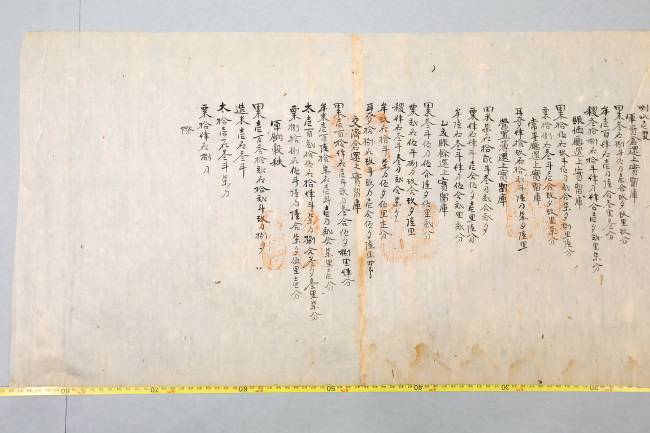
This 7-meter-long document details the arsenal in the camp. It categorizes 300 weapons into bow and arrow, artillery, edged weapon, signaling equipment (drums, flags) and defense equipment (shield, caltrop).
Yoon recorded 14,111 iron bullets, 4,997 caltrops, 343 rifles and 670 "pyunjeons." A pyunjeon is a short arrow, invented during the Joseon era, which is half the length of an average arrow.
"In 'The Fatal Encounter,' a recent historic film about King Jeongjo, the king frequently uses and speaks very highly of pyunjeon as clear, marvelous and strong, incomparable to other arrows," said Kim Song-hye, vice director of the Korea Army Museum at the press viewing of the document. "This document demonstrates that pyunjeon was not only used by the king, but also across all the way to the northern district."
Aside from the list of weapons, the document inventories military provisions, including rice, bean, barley and millets.
One hundred haeyu documents from the Joseon era remain today, but only seven of them were written by officers based in provinces.
"The document is significant in that it is the first of its kind from North Hamgyong Province, which will serve as a key reference in studying the defense posture on the northern border at that time," Kim Hyo-kyung, a researcher at the library, said.
In the 18th century, the Jurchen people from Manchuria increasingly threatened to invade the northern region of the country.
By Ahn Sung-mi (sahn@heraldcorp.com)< ⓒKoreaHerald(www.koreaherald.com)무단전재 및 재배포 금지 >
Copyright © 코리아헤럴드. 무단전재 및 재배포 금지.