Banh mi at Tamarind
A good banh mi sandwich starts with the baguette.
Not only because the baguette essentially gave birth to today's banh mi, but because it seems to matter, deeply, that the very bread cradling all that deliciousness inside be perfectly soft yet crackly, taking the lead gently as the conduit between you and all those tasty fillings.
Served up warm, the bread used for the Vietnamese-style sandwiches at Tamarind by Miss Saigon seems to do just that.
"Banh mi bread is very important," said Tamarind owner-chef Lee Don-hee, who started his first restaurant, Miss Saigon, in 2009.
Lee showcases the popular Vietnamese street dish at his latest enterprise, Tamarind, a contemporary Vietnamese restaurant that opened in Hannam-dong last July.
Suffice it to say, Lee knows that the baguette plays a key role in the construction of a solid banh mi, which is why he sticks to his ideal of good banh mi bread by using a relatively short baguette with a maximum 2-inch girth and what he describes as a "flaky" and "crumbly" crust.
Indeed, "banh mi" literally means "bread" in Vietnamese, which makes sense when one discovers that the banh mi sandwich's roots harken back to the period of French colonial rule, between the 19th and 20th century, when the French baguette landed in Vietnam.
There is no definitive banh mi sandwich. In Vietnam, there are many different varieties of the dish, including a breakfast version featuring eggs.
Tamarind's sandwich derives its basic frame from the version with meat, called banh mi thit.
Instead of the usual mayonnaise, Lee and crew slather their baguettes with a housemade peanut spread, before layering on daikon and carrot pickles, cilantro and red and green chilies.
A Sriracha-hoisin-mayo blend is added to the mix for that extra layer of flavor, but it is the pork that really completes Tamarind's banh mi.
Lee eschews the more customary ground pork, charcuterie or cold cuts for thick strips of pork butt. To keep the meat tender, the pork is marinated in sugar and salt before being basted with housemade barbecue sauce while being grilled to order.
Then the whole thing is assembled and served with a small heap of uber-crisp, thick-cut fries.
From the crackly baguette crust down to the juicy, steak-like pork and medley of sour, nutty and piquant flavors, Tamarind's banh mi sandwich definitely hits the spot.
|
|
Tamarind's eggplant dumplings with chili sauce feature beer-battered, pork-filled eggplant fritters and a fresh green salad dressed in balsamic vinegar. (Yoon Byung-chan/The Korea Herald) |
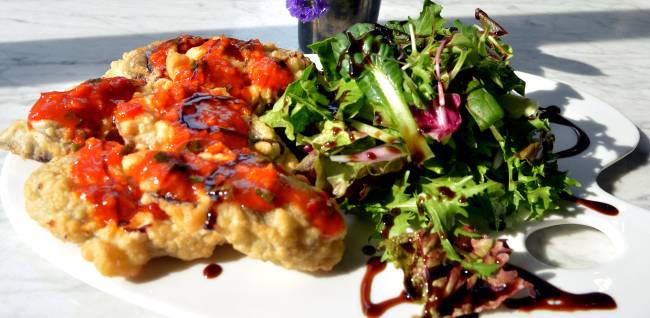
The same epicurean spirit is infused into the other dishes at Tamarind like the establishment's eggplant dumplings.
The word "dumpling" does not quite capture the plateful of eggplant and meat beer-battered fritters that are served up.
Lee and team have scored each huge chunk of eggplant to create thin layers of eggplant that are then stuffed with a ground pork, vegetable and glass noodle filling.
Topped with chili sauce, each morsel, with its alternating layers of eggplant and ginger-inflected pork filling, is crunchy, hearty and flavorful.
A fresh green salad that comes with the fritters rounds out the beer-friendly dish.
While the salad sports an Italian vibe with its balsamic vinegar dressing, Lee says he avoids the umbrella term "fusion" to describe his cuisine.
"Seventy percent of our menu is Vietnamese," Lee said, adding that the remaining 30 percent exhibits Western and Chinese influences.
His goal was to create a "clean, comfortable and modern space" where patrons could come for relaxed bite or two in an elegant hideaway.
Now seven months into business, Tamarind's menu is still growing.
Lee revealed plans to put all that culinary craft to good use on their still-evolving dessert menu, but either way is fine, so long as the banh mi and eggplant dumplings are here to stay.
|
|
contemporary Vietnamese eats. (Yoon Byung-chan/The Korea) |
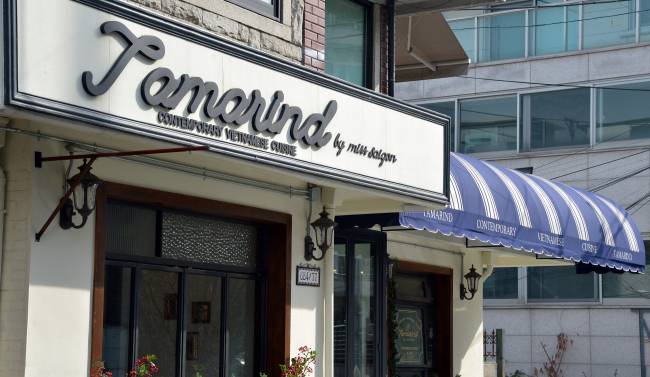
Tamarind by Miss Saigon
684-77 Hannam-dong, Yongsan-gu, Seoul (02) 794-8780
Open Tuesdays through Sundays from 11:30 a.m.-3 p.m. and 5-9 p.m., closed Mondays
Banh mi sandwich set costs 10,000 won for lunch, 12,000 won for dinner; eggplant dumpling with chili sauce costs 15,000 won for lunch, 18,000 won for dinner
By Jean Oh (oh_jean@heraldcorp.com)< ⓒKoreaHerald(www.koreaherald.com)무단전재 및 재배포 금지 >
Copyright © 코리아헤럴드. 무단전재 및 재배포 금지.