Moral Education at the Table
이 글자크기로 변경됩니다.
(예시) 가장 빠른 뉴스가 있고 다양한 정보, 쌍방향 소통이 숨쉬는 다음뉴스를 만나보세요. 다음뉴스는 국내외 주요이슈와 실시간 속보, 문화생활 및 다양한 분야의 뉴스를 입체적으로 전달하고 있습니다.
On April 11, a depressing article appeared in. It reported that our fishing vessels were evoking international criticism for excessive fishing in the Antarctic Ocean and the waters of Africa.
The United States warned South Korea that they would initiate trade sanctions, if we did not strengthen our domestic regulations on deep-sea fishing. In fact, this problem is not that simple.
The fishing industry dominated by powerhouses armed with fine equipment; the reality of deep-sea fishing, which has been cornered by the depletion of fisheries and a fishing quota; the human desire to eat ever more fish; and the problem of food sovereignty of many African countries are all tangled up in this issue.
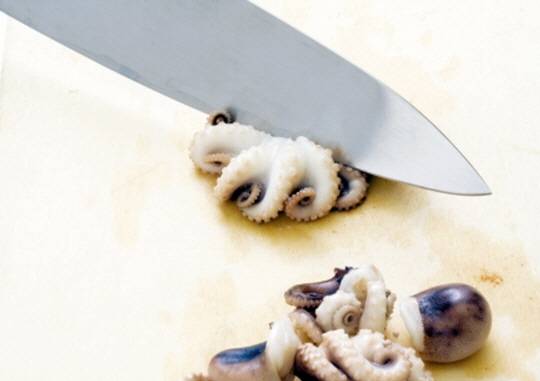
Hands trimming the webfoot octopus with a knife
Add to this people, who look on in discontent as consumption of fish as well as dairy products and meat surge in major countries which are growing in their power as well as in their fishing industry, particularly China.
This is another story, but I can't help thinking that the people who worry about the increase of consumption in China are mean. The worst fears about China, which I have heard of, are actually cheap shots such as "If everyone in China uses toilet paper, the earth's tropical rain forests will be destroyed in no time."
Don't the Chinese have a right to use toilet paper? If Chinese children increase the consumption of milk, is that a threat to the earth? This is no different from claiming that the people riding a bus are polluting the environment, while driving by in a car with an 8-cylinder engine. Even if their desires threaten the well-being of our planet, people like us, who consume massive amounts of toilet paper and milk daily, have no right to criticize them.
Anyway, currently the Earth is burning from a desire to consume more products. 3.7%: that is the rate of Korea's food self-sufficiency. That is about where we are. When I cook, I sometimes wonder, "Wow, do we have to import and eat things like this?" They are completely different from milk and toilet paper. As the price of octopus rose, we started importing them from North Africa.
We catch or buy hairtail from Senegal, a problematic area mentioned in the latest reports, and release them in our markets. Octopus and hairtail are fish which commonly decorate our tables, but they are also food which we can eat less of when expensive. Recently, I even saw this ad in a major supermarket: "Webfoot Octopus, Flown in from Southeast Asia!"
Since when did we have to have webfoot octopus? Is it something we have to eat, while burning jet fuel and large amounts of chemical energy for refrigerated transport? Eating when it's there and patiently doing without when it's not: where has this virtue gone? One company mentioned in the article caused a stir for catching an excessive amount of tooth fish, far surpassing the regulated amount, in the Antarctic Ocean.
Tooth fish live in the deep seas and its chewy and oily meat is delicious. However, not eating tooth fish will not cause any problems in our diets. How many Koreans have ever had tooth fish? The current century already demands awareness and patience in the matter of eating.
The world seems to view this issue as something pointing towards a deadline for the Earth's survival rather than as a moral issue. These days many people have opted to become a gourmet as a hobby. For once, we need morality at the table.
Copyright © 경향신문. 무단전재 및 재배포 금지.
- [속보]윤석열 ‘명태균 무상 여론조사’ 1심서 징역 2년···김건희 ‘무죄’ 판결과는 달랐다
- 한달째 미궁 통영 60대 살인 사건···제보자에 최고 1억 신고보상금
- 영안실 4년째 못 떠난 강 하사의 사체…군은 ‘순직’ 인정 보훈부는 미인정, 무슨 일이
- 장윤기 “강간 등 살인 인정”···피해자 측 “반성문, 형량 감경 꼼수”
- 피 흘리며 알몸 배회한 살인 피의자···경찰, 마주치고도 놓쳐
- [단독]강호필, 국회의 계엄 해제 의결 전에 참모에게 “2사단 출동 가능한가”
- [속보]박홍근 예산처 장관 “내년 예산 800조원대로”···올해보다 10% 이상 확대 편성
- “9평 원룸 관리비가 50만원? 아파트보다 더 비싸”···국토부, ‘꼼수 인상’ 제동
- 정청래 “당대표직 이용해 대선 출마 안 할 것”…당대표 출마 선언
- [의원님은 수주왕] ‘수주왕’을 공개합니다…전수조사로 드러난 수의계약 의혹 지방의원은 누