[Human Rights in North Korea, Beyond the Progressive vs. the Conservative] Human Rights is Not a Political Tool
이 글자크기로 변경됩니다.
(예시) 가장 빠른 뉴스가 있고 다양한 정보, 쌍방향 소통이 숨쉬는 다음뉴스를 만나보세요. 다음뉴스는 국내외 주요이슈와 실시간 속보, 문화생활 및 다양한 분야의 뉴스를 입체적으로 전달하고 있습니다.
Human rights in North Korea have become everyone's favorite punching bag. Yet although everyone joins in on the argument, no one seems to be able to present a concrete solution. People approach this problem as an ideological or political issue, rather than see it as a pure human rights issue.
Saenuri Party's Park Geun-hye, Democratic United Party's Moon Jae-in, and the independent Ahn Cheol-soo: whoever becomes the next president, that person will have to improve inter-Korean relations, which have fallen apart under the Lee Myung-bak government.
But the conflicts in South Korea surrounding North Korea's human rights issue show no sign of resolution.
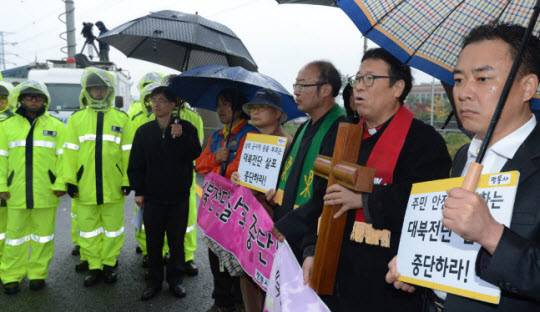
On October 22, the police block vehicles with propaganda leaflets against North Korea near Dangdong interchange on Freedom Avenue, when members of Fighters for Free North Korea tried to scatter the leaflets at Imjingak, Paju in Gyeonggi Province. Members of Solidarity for Peace and Reunification of Korea, who were heading for Imjingak to denounce the release of propaganda leaflets against North Korea, hold a press conference on Freedom Avenue. Kim Chang-gil
The blame is not solely on the Lee Myung-bak government's decision to emphasize North Korean human rights instead of inter-Korean dialogue, eventually acting as an outlet for the conflicts within the South.
After all, the current situation is just an outcome of the long-standing confrontation between the progressive and the conservative. Then is a conflict among South Koreans inevitable no matter who takes office?
Fortunately, some in the progressive and conservative circles have started to reflect on their past ways. The conservatives are aware that it is unrealistic to expect the collapse of the North Korean regime to solve everything.
North Korea, which sees the conservatives' expectation as an attempt to take down their regime, will only tighten their grip leaving their people under worse circumstances.
The progressives, who have been at the forefront of improving human rights in South Korea, have faced criticism that they should advocate North Korea's human rights under the universal principles of mankind including the right to political freedom.
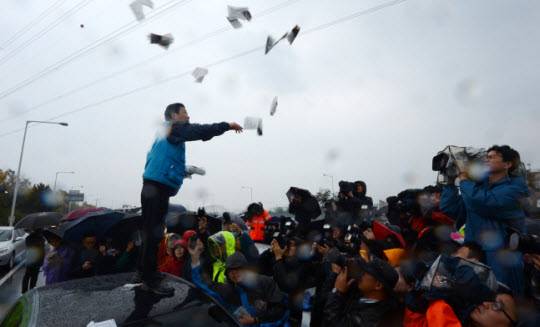
On October 22, a North Korean defector is throwing leaflets in protest to police action, when the police blocked the vehicle of a North Korean defectors group near Dangdong intersection on Freedom Avenue. The group attempted to scatter propaganda leaflets against North Korea from Imjingak. Kim Chang-gil
They can't convince the people with their current attitude: they insist on sticking to humanitarian aid only until important issues are resolved, such as establishing peace on the Korean peninsula. Of course, in reality, any effort will be limited without North Korea's willing participation.
The progressives and conservatives should view North Korea's human rights issue as a human rights issue, and vow not to use it as a political tool. Only when they observe North Korea's human rights issue through a lens faithful to the universal principle on human rights, will the progressive and the conservative be able to come together and use it as a key to unlocking inter-Korea relations.
As highlighted at the 1993 World Conference on Human Rights in Vienna, the right to life and the right to political freedom are values that should be pursued together. Yet the progressive and the conservative have been wrestling each other for the past ten years, putting their pride first.
Whoever takes office, they cannot treat North Korea's human rights movement as the South's political problem. In particular, the progressives have to take part in order to convince North Korea that improving human rights works to their benefit, smoothing the path out for North Korea to join the international society.
The Kyunghyang Shinmun does not see the current arguments in South Korea as our inevitable fate, but rather a challenge we can overcome when the citizens reach an agreement. The presidential election, in particular, will provide a good forum for the progressive and the conservative to discuss and build the foundation for agreement.
Even if we can't reach an agreement, if we can at least find some sort of common understanding on conflicting elements such as North Korea's human rights issue, it can be proof that we can resolve a significant portion of our social conflicts through dialogue. This is why we need to further discuss North Korea's human rights now.
Copyright © 경향신문. 무단전재 및 재배포 금지.
- UAE, 내달 1일 ‘OPEC 탈퇴’···호르무즈 봉쇄 장기화에도 독자적 증산 나서나
- ‘조국 저격수’ 김용남 “먼저 공격 안 해” 혁신당 “민주당 우군 맞냐”···재보선 핫플 ‘
- [속보]이 대통령 “하정우 수석, 큰 결단했다…어디에서든 국가·국민 위해 역할 하길”
- 도이치 주가조작 ‘유죄’ 뒤집힌 김건희, 2심 ‘징역 4년’···“시세 조종 가담, 중대 경제 범
- “오배송 책임 전가” 거센 반발에 결국···쿠팡이츠 ‘라이더가 메뉴 확인’ 하루 만에 중단
- [단독]“생각보다 빡빡한 선거될 수도, 절대 오만해선 안돼”···민주당, 비공개 의총서 ‘내부
- MBC ‘추경호 클로징 멘트’에 국힘 “사과 안 하면 취재 거부”···‘선거 개입’ 주장
- ‘진짜 사나이’ 출연했던 해군 첫 여소대장, 최초 주임원사 역사 썼다
- 30년 넘게 제사 지냈는데…대법 “종손 지위는 양도 불가능”
- 대학 붙어 자취방 구했는데 입학 취소?…농어촌전형 거주요건 완화