National Opera Chorus disbanded but more committed than ever
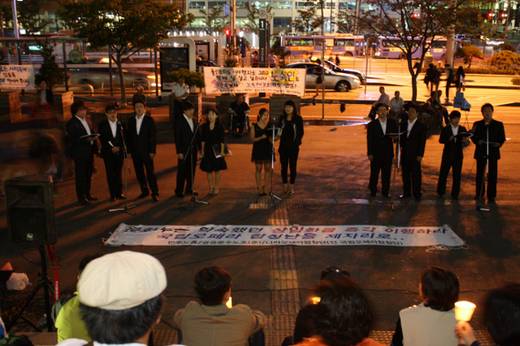
[한겨레] The group members refused to sign a pledge not to engage in collective activity
By Park Tae-woo
As a crisp early autumn breeze blew over the square in front of Seoul Station on Thursday evening, a beautiful harmony echoed forth from dismissed workers from the National Opera Chorus. The stage for their autumn recital was the asphalt in front of the station. The only marker to let passersby know this was a stage was a banner on the ground reading "Put the National Opera Chorus back to work."
The recital began to an instrumental accompaniment on an MP3 player. Because of the feedback from the old speakers, it took over ten minutes to adjust their position.
Checking the sound from the top of the staircase, member Cho Nam-eun, 39, said, "In a chorus, the harmony among parts is important, but there are no altos at all here, three sopranos, two basses, and six tenors."
"I do not know whether we can provide good music for the citizens," Cho said.
The reason the members were forced into this poor environment, singing to their orchestral accompaniment under the bright lights, is because the National Opera Chorus was disbanded. Affiliated with the Korea National Opera, the opera chorus was founded in 2002. After the Lee Myung-bak administration took office, it was dissolved in 2009 for not being an official organization. As the situation became a social issue, with the members forming a labor union to battle the decision, the Ministry of Culture, Sports and Tourism (MCST) formed the Nara Opera Choir, signing the members to one-year contracts. Prior to contract renewal in April, the ministry said it would not be employing the members unless they signed a pledge "not to engage in any collective activity or raise any objections after support ends in April 2012."
"After saying three years ago that it would make us permanent, the ministry changed its position and said they would be contract positions," said Mun Dae-gyun, 34, head of the National Opera Chorus chapter of the Korean Public & Social Service Workers' Union (KPSU). "Now, it is also banning collective action."
"We cannot find ourselves out into the street once again in a year's time," Mun added. "So we are demanding to be made permanent without signing any pledge."
The 12 of 30 members who remain hold weekly assemblies in front of MCST. Capable of perfectly performing around 50 opera choral works, the union members are scraping by with part-time work at churches and other opera companies. Most of them will see their monthly unemployment benefit of 800 thousand won ($742) expire in September.
Lasting a little over an hour, the performance was a success. A hundred or so commuters and travelers stopped to see the ensemble. Their shoulders moved during the performance of the "Drinking Song" from Verdi's "La Traviata," and applause rang out when 33-year-old member Seo Seok-ho performed "This Is the Moment" from the musical "Jekyll & Hyde."
"Every time we have one of these performances, I find myself yearning to return to the stage," Seo said. "I want to give the citizens good music in a good environment."
Mun said, "There are over a hundred opera companies in the country and dozens of opera houses, but there is no formal opera chorus that can actually give opera performances."
"The National Opera Chorus needs to be made permanent, if only so that South Koreans can be provided with better cultural benefits," Mun added.
Please direct questions or comments to [englishhani@hani.co.kr]
공식 SNS [통하니][트위터][미투데이]| 구독신청 [한겨레신문][한겨레21]
Copyrights ⓒ 한겨레신문사, 무단전재 및 재배포 금지
<한겨레는 한국온라인신문협회(www.kona.or.kr)의 디지털뉴스이용규칙에 따른 저작권을 행사합니다.>
Copyright © 한겨레신문사 All Rights Reserved. 무단 전재, 재배포, AI 학습 및 활용 금지