Allegations expand to civilian mobilization for DMZ dump
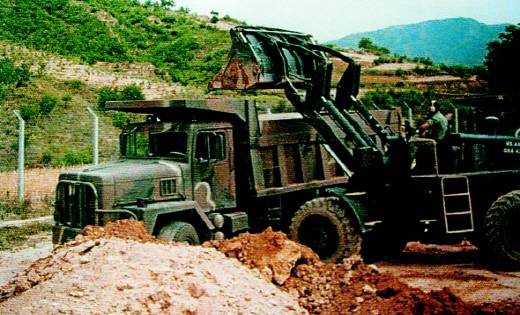
[한겨레] Mobilization of S.Koreans may impact the USFK's current lack of environmental accountability
By Nam Jong-young
Allegations have surfaced claiming that the spraying of defoliant in the Demilitarized Zone, which reportedly took place only through the late 1960s, actually continued into the early part of the next decade. Eyewitnesses are also saying that civilians were mobilized as part of the effort.
In a telephone interview Wednesday with the Hankyoreh, Gwon Jong-in, a 74-year-old resident of Saengchang Village near the DMZ in Cheorwon County, Gangwon Province, said he took part in a weed-killing effort around the DMZ ceasefire line in the spring of 1971 and 1972 at the request of a military base.
"The soldiers gave us a powder that was like sorghum, in sacks resembling cement bags with skulls and umbrellas drawn on them, and we mixed it with water and sprayed it with atomizers," Gwon said.
Gwon also said, "After laying down sand under a wooden fence with barbed wire on it, we sprayed the stuff so that the weeds would not grow."
"A lot of people from outside went and helped with it," Gwon continued, adding that the soldiers told them the powder was "poison to prevent weeds from growing" and that he only learned it was defoliant later after controversy erupted over the Agent Orange used during the Vietnam War.
Since his work with defoliant, Gwon has suffered from tuberculosis and asthma.
Previously, it was believed that the South Korean Army used defoliant in the DMZ only twice in the late 1960s, under the direction of the U.S. military according to "Vegetation Control Plan CY 1968."
In connection with this, it was confirmed that the U.S. government extended the injury compensation period for U.S. soldiers in charge of the DMZ spraying effort by two years from the officially confirmed spraying period, suggesting that the U.S.-led defoliant spraying continued into the early 1970s.
In an official U.S. government telegram dated Jan. 25 of this year, the U.S. Department of Veterans Affairs confirmed that compensation for injury resulting from DMZ defoliant spraying applied to U.S. soldiers who worked in the area between April 1, 1968, and August 31, 1971. This period is more than two years longer than the official spraying period of April 1, 1968, to July 31, 1969.
Meanwhile, Korean-American blogger Chi Yong An announced on his Web site "Secret of Korea" Tuesday (local time) that a U.S. Defense Department report commissioned from a U.S. academic showed the amount of monuron sprayed in the DMZ to be around fifty times greater than announced by the South Korean Ministry of National Defense in 1999.
At the time, the ministry said that 7,800 pounds of monuron had been sprayed in 1968. But a report commissioned by the U.S. Defense Department from herbicide authority Allen Young and submitted to the Ministry of National Defense in December 2006 stated that the amount was 7,800 drums, or 397,800 pounds, a conspicuously larger quantity. As a basis for his figures, Young used the U.S. Military Advisory Group's Vegetation Control Plan.
The report also said "During the Korean Conflict, the DoD developed the first major tactical herbicide, Herbicide Purple, although never deployed. Subsequently, for Vietnam the DoD developed, tested, evaluated, and deployed five additional tactical herbicides, Herbicide Pink, Herbicide Green,Herbicide Blue, Herbicide Orange, and Herbicide White."
The title of the report is "The History of the US Department of Defense Programs for the Testing, Evaluation, and Storage of Tactical Herbicides" in December 2006 submitted by Alvin L. Young, Ph. D. for Office of the Under Secretary of Defense.
Jung In-chul, head of Green Korea's Peace Action Bureau, said, "Allegations that additional sprayings of defoliant left over from the Vegetation Control Plan operation took place through the 1970s have been repeatedly presented over the years."
"The government also needs to undertake a thorough investigation into the additional spraying and damages to the surrounding environment and residents," Jung added.
Meanwhile, the USFK will use ground-penetrating radar devices next week for tests of soil on one of its bases where large amounts of Agent Orange were buried, the chief investigator in the claims said Thursday.
North Gyeongsang Province's Chilgok County began a search for civilian workers who took part in the Camp Carroll defoliant burial over thirty years ago, as well as witnesses to the burial.
Please direct questions or comments to [englishhani@hani.co.kr]
공식 SNS [통하니][트위터][미투데이]| 구독신청 [한겨레신문][한겨레21]
Copyrights ⓒ 한겨레신문사, 무단전재 및 재배포 금지
<한겨레는 한국온라인신문협회(www.kona.or.kr)의 디지털뉴스이용규칙에 따른 저작권을 행사합니다.>
Copyright © 한겨레신문사 All Rights Reserved. 무단 전재, 재배포, AI 학습 및 활용 금지