Report calls for reform of antismoking policies
More than a 10th of the world's countries, excluding Korea, have implemented graphic health warning labels on cigarette packs with many seeing positive results, a report found Monday.
According to the report by research fellow Suh Mee-kyung at the Korea Institute for Health and Social Affairs, roughly 70 million people in 27 countries encounter the graphic labels that depict the hazards of smoking.
England, New Zealand, Singapore and other leading economies have adopted a graphic warning label of some sort, and have seen a reduction in the number of smokers since the labels have gone into effect.
|
|
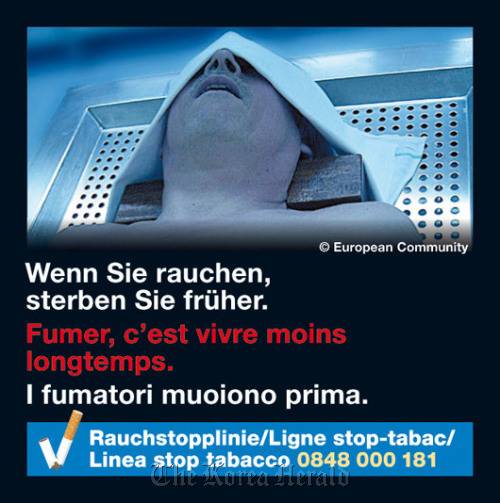
Graphic health warning labels adopted by 27 countries have seen positive results. |
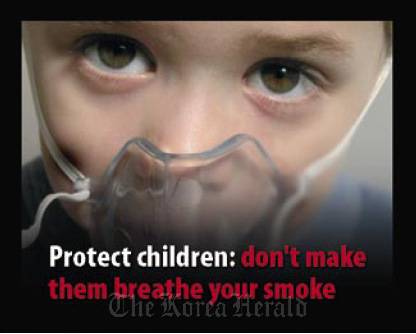
Graphic warning labels for cigarette packs contain macabre pictures regarding cancer, impotence, gangrene and other negative health effects of smoking.
Canada, the first to adopt graphic warning labels on their cigarette packs in 2000, has seen a steady decrease since. In 1999, Canada's total smoking rate was 25 percent and its rate for teens ― 15 to 19-years-old ― was 28 percent. However, in 2006, five years after the label appeared on packs, total and teen smoking rates were at 18 and 16 percent, respectively.
Canadian graphic warning labels cover at least 50 percent of the packs' front and back sides.
In Brazil the graphic labels also include the telephone number of a smoking cessation hotline, which has led to not only an increase in callers, but a decrease in smokers. According to the report, over the course of one year from July 2001, call centers have seen a 1,000 percent increase in the number of callers.
Brazilian cigarette packs started showcasing graphic labels in 2002; they cover 100 percent of the back's surface area.
Australia has also seen a 100 percent increase in the number of callers to their smoking cessation hotlines, since the graphic warning labels ― which cover 30 and 90 percent of the front and back of packs, respectively ― were implemented in 2006.
"As one of the countries that fall under the WHO Framework Convention on Tobacco Control ― a treaty negotiated in response to the globalization of the tobacco epidemic ― we have a responsibility to implement the graphic warning labels and effective antismoking policies," said Suh.
Korea will host the fifth meeting to discuss the FCTC in 2012.
In her report she emphasizes that Korean cigarettes should have warning labels that describe the hazardous effects of smoking through graphic pictures that cover up to 50 percent of the front and back surface areas of the packs.
"Even though a bill has been submitted (to the National Assembly), it is taking a fairly long time to pass," she said.
Currently, Korean cigarette packs only have a black and white warning label reminiscent of a chemistry textbook, which covers only 30 percent of the front and back surface areas.
According to Suh, there are five countries in the Asia-Pacific region that have adopted graphic warning labels on cigarette packs ― Singapore, Thailand, Australia, China (specifically Hong Kong) and New Zealand.
In 2012, the U.S. will also see graphic warning labels on the front and back of cigarette packs.
By Robert Lee (rjmlee@heraldm.com)
Copyright © 코리아헤럴드. 무단전재 및 재배포 금지.