[Alice Hyun-Kyung Tan] Spotlight on diabetes
James is a 38-year-old manager at an investment firm. One winter morning while rushing to catch the subway to work, he noticed a slight twinge in his chest. He decided to ignore it, and scurried down the stairs of the subway station. On the subway, he was distracted by the growing discomfort in his chest, which was now no longer ignorable. He regretted the double latte that he drank with breakfast, thinking that perhaps the coffee was giving him heartburn. At his stop, he ran up the stairs of Exit 2 and then collapsed, fortunately, on ground level. James was delivered by ambulance to one of the major hospitals in Seoul, and lucky for James, the doctors were able to open up the clogged blood vessel in his heart which had caused that morning's heart attack. Routine blood tests done the following morning showed that James' fasting blood sugar was 316 mg/dL (normal is up to 100), and the hemoglobin A1c (a test of blood glucose levels averaged over the last three months) was 10.4 percent (nondiabetes is up to 6.5 percent). James was diagnosed with diabetes mellitus, and was referred to an endocrinologist for diabetes management.

Upon careful questioning, James revealed that he had not felt well for the last few months. He had noticed that he was always thirsty, and was going to the bathroom to urinate more frequently. Even after drinking three to four cans of soda, his thirst could not be quenched. Last month, he caught a cold from his 3-year-old daughter, but his symptoms dragged on for weeks before finally subsiding. Recently he found himself simply exhausted the day after a late business dinner with clients. James even admitted bashfully that his sexual function had faltered for several months now.
The testing ordered by the endocrinologist showed that the diabetes had not only affected the blood vessels in James' heart, but also those of his eyes. There was also a small amount of protein found in his urine, indicating damage to the kidneys. Testing of the nerves of James' feet showed that the diabetes had not yet caused nerve damage in that region.
James started taking medicine for diabetes, high cholesterol, and heart disease, and he and his wife met with a certified diabetes educator and a certified dietician to discuss how James needed to modify his diet, increase his level of exercise, and manage diabetes at home and at work. In early spring, James returned to the outpatient clinic a changed man. He quit smoking, stopped drinking soda, limited alcohol intake, stayed away from greasy foods, and exercised three days a week. At the end of the office visit, the endocrinologist congratulated him on his phenomenal effort and let him know that his hemoglobin A1c had decreased to 7.3 percent, and that both blood pressure and cholesterol levels were on target. James' wife could not conceal the tears which welled up in her eyes as she finally heard the message which she was longing to hear ever since nearly losing her husband three months ago: that James was finally on the road to recovery.
James' story vividly illustrates some of the symptoms and consequences of untreated diabetes. Here are some facts about this deadly and prevalent, but manageable disease.
What is diabetes?
In Latin, diabetes mellitus means "honey urine." It is a disease in which there is an abnormally increased amount of glucose in the blood. When the blood glucose level is very high, it can cause a high level of glucose in the urine, which is how the disease got its name.
Diabetes is a complex disease, and the exact cause is still unknown. The central problem in diabetes, however, is a deficiency of a hormone called insulin. This deficiency may be absolute, as in type I diabetes, or relative, as in type 2 and gestational diabetes.
|
|
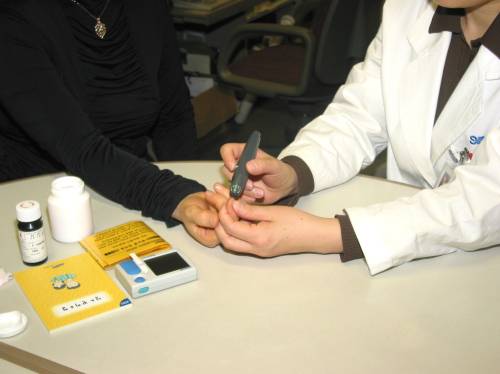
A diabetes patient receives a blood sugar test. (Samsung Medical Center) |
What are the symptoms?
Weight loss, frequent urination, drinking large amounts of fluids and blurry vision are the typical symptoms of diabetes. In extreme cases, the initial symptom can be loss of consciousness, or passing out. Diabetes can be present for months or years before the patient feels any abnormality at all. During this "silent period," however, diabetes can cause damage to the eyes, kidneys, nerves, and blood vessels; therefore, screening for the disease is important.
Who are at risk groups?
The American Diabetes Association recommends screening for diabetes in the following persons:
1. Anyone who is overweight (with body mass index greater than 25 kg/m2) is considered to have at least one additional risk factor for diabetes. (BMI is measured by dividing a person's weight by the square of his or her height in meters.)
2. Everyone who is 45 years old or older
What are the complications?
The long-term consequences of uncontrolled diabetes include blindness, stroke, poor wound healing, heart attack, kidney failure, erectile dysfunction, decreased circulation to the legs and feet, decreased sensation or pain in the feet and amputation of the toes or foot.
Is diabetes preventable?
Yes! Studies have shown that diabetes can be prevented or at least delayed with counseling with specialists, weight loss, increased physical activity, and in some patients, medication.
How to treat diabetes
The foundation of diabetes treatment is eating a healthy diet tailored for diabetic patients, exercising regularly, and maintaining an ideal body weight. In addition to these lifestyle measures, medications in the form of pills or injections are commonly used. Surgery can be used in cases of extreme obesity. Stem cell therapy and pancreatic cell transplantation are also being investigated as potential treatments for diabetes.
How to learn more about diabetes
In Korea, the Korean Diabetes Association and the International Diabetes Federation will be hosting a multi-national conference in Busan on Oct. 17-20 with many activities planned to help educate patients with diabetes. The International Diabetes Federation (www.idf.org), the American Diabetes Association (www.diabetes.org), and the Korean Diabetes Association (www.diabetes.or.kr) are also excellent sources of information for patients and families. If you think that you may have diabetes, or would like to be screened, please talk to your doctor for prompt testing.
By Alice Hyun-Kyung Tan
The writer is an endocrinology specialist at International Health Services Clinic, Samsung Medical Center
Copyright © 코리아헤럴드. 무단전재 및 재배포 금지.