[Korea-Japan 100 years on (10)] Variety in content is key to success in Japan
For more than 15 years Hoon Kim, a creative director for a London-based advertising agency, has been a self-described "fanboy" of all things related to Japanese pop culture.
From movies, music, television dramas, to even collecting vintage Japanese print art from the 1960s and '70s, the 30-year-old has been an avid consumer of all things Japanese.
This is something not a lot of Koreans would like to admit, but fanatics like Kim are quite common.
To illustrate the scope of his obsession, Kim has more than 200 comic books, or manga, as they are called, hundreds of J-pop records and films on DVD, a scrapbook full of award-winning graphic art from decades past, and "about 80 gigs" of downloaded Japanese television shows, also known as J-Doromas, archived on his computer.
"Back in high school I had to rent them on these ghetto VHS bundles from our neighborhood video store," Kim said.
"The quality used to be horrendous because the woman who ran the store would tape new episodes over old ones over and over again -- I've got technology to thank now for having easy access to these shows, because they're all available for download online in high definition."
Long before the term "Hallyu" was coined and packaged by the local press, a legion of fanatics obsessed with Japanese popular culture like Kim have been around that injected billions into the pockets of its neighbor's entertainment purveyors.
So popular were they that the huge demand spawned a black market, which Asian consumers were more than happy to feed -- turning it into a multi-billion dollar piracy machine throughout Asia.
The consensus has been, for the cutting edge in fashion trends, music, anime, comic books, Japan has always set the tone for the entire Asian region.
So what makes pop-culture from Japan so attractive to people like Kim?
"The stories that come out of that country are very unique and different from what you usually see," he said. "You get to learn and pick up interesting nuances that are obviously exclusive to their culture and way of living that give their products texture. They're not just copying Western popular culture. They might be inspired and influenced by it, but they never emulate."
In 2002, a modest budgeted KBS2 television drama "Winter Sonata" swept through Japan and the rest of Asia with its tale of lost love.
Its plot was simple, straight forward, and firmly rooted in the classic melodrama genre headlined by two picture-perfect actors in Bae Yong-joon and leading lady Choi Ji-woo.
The two would go on to become the mascots for the beginning of the so-called Korean Wave.
The series was a ratings bonanza and its large viewer-ship in Japan opened the flood gates of an endless stream of press coverage by Korean media.
But in reality, much of its publicity had been centered on ratings figures, while a glaring fact had been ignored -- the average demographic of the show's viewers were mostly women well into their 40s.
Despite carrying a narrow range in its target audience, Korean headlines went ahead and loudly emblazoned their pages declaring how the Korean Wave had hit Japan hard.
Subsequent shows like "Jewel in the Palace" in 2003 starring Lee Young-ae parlayed the momentum that began with the Bae Yong-joon tearjerker for several more years.
Its actors milked the notoriety gained from the two shows until, inevitably, people got bored.
The Korean Wave had turned out exactly the way the cynics had predicted with a sharp decline in recent years, due to a lack of "killer content," a term label-happy pundits have coined.
"The decline of the Korean Wave can be attributed to our industry being insistent on relying on the popularity of its stars, rather than relying on the strength of our cultural content," said Lee Ho-jae, writer-director of last year's sleeper hit "The Scam," which also starred late actor and popular Hallyu star Park Yong-ha.
"Film studios and broadcasters are responsible as well, because they treated the phenomenon exactly as its moniker implied -- like a fad, and they moved fast to squeeze it for everything it had.
"Fact is, they've run out of ideas."
The drought in original stories has affected the local industry so much, producers have begun to adapt previously published or televised material from Japan.
|
|
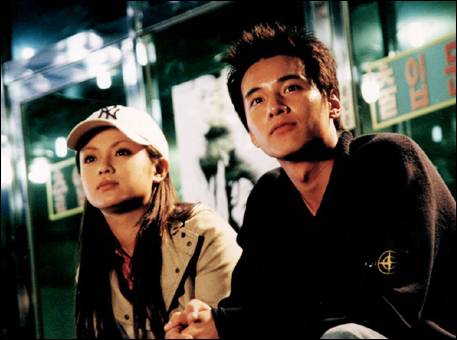
Fukada Kyoko (left) and Won Bin star in the Korea-Japan television co-production "Friends" in 2002. MBC, TBS |
Last year's ratings juggernaut "Boys over Flowers" for example, was based on the Japanese manga of the same name.
The last Korean television series to have moderate success in Japan was "Spring Waltz" -- the last of the four seasons series.
The show recorded a meager 5 percent viewership in its time-slot -- a far cry from the 30 percent "Winter Sonata" recorded when it first aired in Japan.
"Damo," another period piece that was touted as the next "Jewel in the Palace" also failed to ignite much excitement in Japan, notching just 5 percent.
Industry experts say the lack of demand for Korean television dramas has been due to the decline in their quality.
|
|
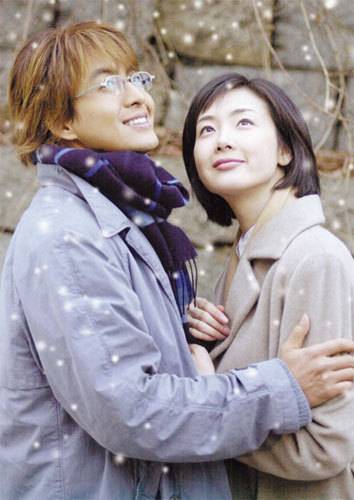
Korean Wave stalwarts Bae Yong-joon (left) and Choi Ji-woo in apromotional still for the hit "Winter Sonata." KB |
One of the common reasons noted by industry pundits is the rise in actors' fees, which they say has taken the focus away from content and more toward using the power of celebrity to sell their product.
"In 2002, an A-list television star earned about 5 million won per episode, but according to 2007 industry standards, top actors get paid 10 times that amount," said Moon Hyo-jin, an expert advisor for the Korea Foundation for International Culture Exchange and editor of the book "Hallyu Forever."
"Because television producers placed all of their bets on their stars to draw in investment and sales to overseas Asian markets, there's been a steep decline in the quality of content."
Moon says that television production companies specializing in large budget dramas such as Kim Jong-hak Productions ("Beethoven Virus," "The Legend") have been bleeding red to the tune of 38 billion won in 2007 and 740 million won in 2008.
Moon says the lack of variety in the stories that are told in Korean television dramas and films have also had a significant impact.
"Foreign buyers are fed up with Korean dramas with plots that usually involve extra-marital affairs, betrayal, birth secrets etc., which form the foundation of most storylines in Korean television dramas," he said. "A lot of these production companies also acquire advances from overseas buyers solely based on the stars that have agreed to headline the project, even before there's a completed script."
"This type of sales-first mentality hasn't helped in creating quality content. It's simply no use to have a popular star to anchor a project if the material is devoid of a compelling story."
In the grim state of the Korean television industry, misery loves company, as overseas interest in Korean films has been in decline.
According to reports from this year's edition of the Cannes International Film Festival, only a handful of Korean films were sold to overseas distributors at the film market during the event in May.
Of them, Kim Ji-woon's western, "The Good, The Bad, and the Weird," was sold to distributors in France and the U.K., while Kim Ki-duk's "Breath" was sold in the U.S. and the U.K.
They were the only two films foreign distributors purchased.
Meanwhile, sales to Japan have decreased an alarming 82.8 percent compared to last year, due in large part to a loss of faith by Japanese distributors in the monetary value of Korean films.
Proving that this wasn't a knee-jerk reaction by the distributors, helping their rationale were films such as the Jang Dong-gun action "Typhoon," Bae Yong-joon's "April Snow," and Kwon Sang-woo's "Running Wild" that failed to generate enough revenue at the Japanese box office.
In stark contrast, Japanese films have recently been making headway into the local market.
In only the second half of this year, 28 Japanese films have been distributed in limited release -- almost double that of the 15 released in 2009.
It's not all doom and gloom for the Korean entertainment industry, however.
At the pop music front, the state of the Korean Wave is less grim as bands such as TVXQ and SS501 have been burning up the Japanese Oricon charts.
Recent singles by both bands have scored No. 1 and No. 5, respectively, while veteran crooner Shin Seung-hoon has been gaining popularity.
In Korea, J-pop, or Japanese pop music, has been steadily picking up momentum, too.
Last November, five-member J-pop idol boy band Arashi held their first concert to a sold out show in Seoul at the Olympic Hall of Olympic Park.
Media reports described the packed show as something of a spectacle, with legions of screaming teenaged fans singing along word for word to the band's songs.
How can Korean pop-culture remain relevant internationally?
Writer-director Lee stresses that variety as the key.
"The reason Japan's pop culture continues to thrive and has remained relevant for such a long time is due to the sheer volume and variety of content available -- they have something for everyone," Lee said.
"Korea is more than capable of creating content on par with Japan, but because there isn't much demand in material considered outside the mainstream, there is no variety -- everything is the same, created in the same mold as say shows like 'Winter Sonata' and 'A Jewel in the Palace.' The reason for this, I think, has more to do with the size of our market and the Korean consumers' unwillingness to be open-minded. In Japan, there is enough demand for content that falls within a wide range of sub-cultures, and I believe that is why their offerings will always be in demand."
By Song Woong-ki (kws@heraldm.com)
Copyright © 코리아헤럴드. 무단전재 및 재배포 금지.