In search of a more perfect you
In a perfect world, the 160 cm Dayna Ahmad said she'd be 13 cm taller. That way her excess baggage would be more evenly streamlined over her frame.
But this is an imperfect world, where the average-size American woman is only 163 cm according to health statistics from the Centers for Disease Control. That's an inch taller than she was in 1960, but that same woman is 11 kg heavier.
It's only natural that Ahmad would have body-image insecurities living in Korea, one of the thinnest nations in the World Health Organization rankings. "I've never heard so many people comment on my weight until I moved here," said Ahmad, who teaches English in Gangneung, Gangwon Province.
Ahmad has gained more than 9 kg in the last three years. She was once a confident size 8, but now she's as uncomfortable with her fuller figure as she is with the running commentary on her new shape. She could do without the not-so-subtle hints from co-workers and unsolicited advice from school administrators.
She's confronted these pudgy demons before."I've done cardio until I was purple in the face and I couldn't breathe anymore," said the 24 year old.
|
|
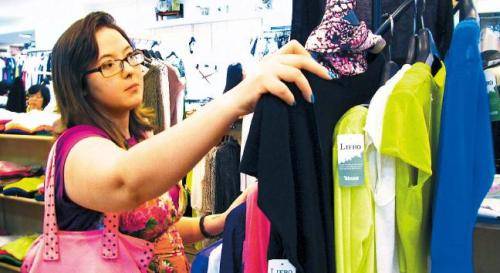
Dayna Ahmad takes in some shopping last weekend. Her search for a "more perfect her" led her to the Beauty Belt of Seoul, at Hus+Hu Clinic, where she and her supportive boyfriend recently went for a consultation. Sonya Beard |
The self-proclaimed "crappy eater" suspects her metabolism is partly to blame. "I don't eat a lot, but I need to know which foods I should avoid," said Ahmad. She realizes she can no longer get away with the same culinary choices she made in college.
Ahmad is the first to admit she needs to make some changes. And she has no shame if those alterations are rendered with a little surgical assistance.
The New Jersey native had contemplated getting a nip and tuck back in the States, but was turned off by astronomical prices and couldn't convince her mother to front the bill. Now that she was making her own way, she could afford to make her own decisions.
Still, that didn't mean her mother was on board with the idea. "She didn't think Korea was that advanced," Ahmad said.
Korea, though, is a burgeoning hub for medical tourism with patients traveling specifically to take advantage of elective and non-elective procedures. More than 60,000 foreigners sought medical attention here last year, said Elly Kim of the Korea Health Industry Development Institute. That's more than twice the number treated in 2008, an increase correlating with recent healthcare legislation spurring more aggressive government regulations.
Korea, too, has become a cosmetic fixer upper's paradise -- the place to go if you're in search of a more perfect you. Ahmad's search led her to the Beauty Belt of Seoul, at Hus+Hu Clinic, where she and her reluctant, but supportive, boyfriend recently went for a consultation.
"We were a campus couple," she said of Chris Kobrzynski, a fellow New Jerseyan and teacher in Gangneung, who was there to watch her bags during the appointment. "I was skinny when we met."
Expats visiting the upscale Apgujeong med spa are greeted by a witty English-speaking staff that instantly eases any nerves associated with doctor visits, especially in a foreign country. Prospective patients are ushered to plush leather sofas where they can browse through glossy catalogs to select from an array of upgrades such as flawless skin or a brighter smile.
Ahmad checked out the body contouring procedures. She's had her heart set on Smart Lipo, a laser surgery that dissolves fat from localized area directly underneath the skin. "I could go to work the next day," said Ahmad, not a fan of invasive forms of Liposuction that would require her body up to six months to recover.
Liposuction is a popular pick for the 2,000 foreign teachers, soldiers and embassy personnel who frequent Hus+Hu each year, says Yeo Myung-jin, a spokeswoman for the clinic. The growing reputation in the international community is one Yeo credits with language ability and affordable prices.
During the consultation, Dr. Chang-Seung-ho asked Ahmad what she'd like to have done. "I'd like my stomach and thighs and arms to be smaller," Ahmad said.
Chang probed her about diet control: "I eat what's fast and cheap." He inquired about appetite suppressants: "I tried diet pills but they all increased my appetite or made me feel sick." And exercise? "I've worked out, but nothing has worked."
The surgeon told Ahmad the words she feared most. "I can't recommend liposuction at this time because there are too many risk factors and side effects," Chang advised.
Point blank: She needed to lose weight.Ahmad looked crushed at the cycle of bad news. She's not heavy enough for more drastic measures such as lap band or gastric bypass procedures. But lipo wouldn't produce her desired results.
The doctor prescribed a healthy eating plan and exercise routine for Ahmad. "Surgery is not a solution to weight loss," Chang said. "But exercise and dieting don't fix the entire problem either."
Chang cautions against rapid weight loss so skin retains elasticity and healthy toning. He explained that surgery is most effective after a well-scheduled diet program and referred Ahmad to a nutritionist. "If you operate without changing those habits," he said, "the fat will grow back in other areas."
Ahmad was appreciative of the honest advice and thorough explanation, something lacking in the consultations she'd had with American doctors. "He could've just taken my money and done the surgery."
That would not be likely in Korea, so horror stories about double-eyelid surgeries gone wrong and rumors about psychiatrists performing tummy tucks should not concern foreigners. There have been dramatic changes in the industry, Kim said. "Medical institutions that treat international patients must meet certain requisites."
According to the KHIDI, healthcare facilities must abide by tougher safety protocols, staff certified physicians based on the areas of specialty, and guarantee insurance coverage. These standards are compliments of a Medical Service Act passed in May 2009 to protect the rising number of foreign patients.
Empowered and informed, Ahmad left the office, nutritionist referral in hand, determined to get in fighting shape for her Smart Lipo.
Yeo offered encouraging words as they walked to the elevator. "We will get in shape together," Yeo vowed to Ahmad with a pinky-swear.
Kobrzynski had little to say about the day's events once the two were taxi bound. "I just came here to hold the bags," he said. "Everyone wants to buy into this notion of beauty. I think people should just be the way they are."
Ahmad shot him an easier-said-than-done look. "Well what am I supposed to do?" she asked, after failing to make it to the dietician's office before it closed."When you do all this work and you have nothing to show for it, it makes you give up hope," said Ahmad, as she continues her search for the perfect body or at least one resembling the one she had before.
To comment, send a message to mattlamers@heraldm.com; to reach the author, e-mail sonyabeard@yahoo.com -- Ed.
By Sonya Beard
Copyright © 코리아헤럴드. 무단전재 및 재배포 금지.