The making of a great trot act
You can't avoid it even if you want to. If you take public transportation, at one point or another you would have been exposed to music that would either spark riotous laughter or at the very least, bemusement.
And chances are you've not only heard it, but actually witnessed the grandiose arm flailings and hip shaking madness of visor-clad, middle-aged Korean women dancing to the music inside tour buses or middle-aged men huddled in a circle drinking soju and makgeolli while munching on fried fish heads and listening to "trot."
|
|
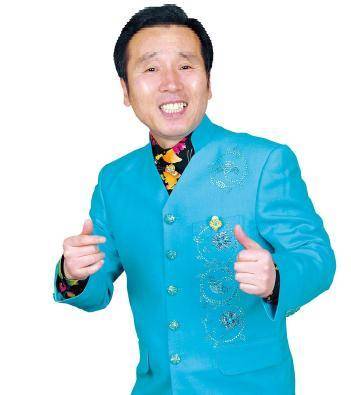
"Moonlight" trot singer Choi Gwang-ho, stage name Choi Bae-ho, sports the typical trot performance get-up of a bright-colored suit. Chung Hee-cho/The Korea Herald |
Trot has always been one of the great social networking tools of the working class of Korea.
But it is also a topic of controversy that has been the subject of debate between the left and the right for over five decades.
In its historical context, there have been those who have chastised the oldest known Korean pop music genre as a shameful reminder of the Japanese colonial era, as it is believed to have derived from Japanese pop music.
However, defenders have dismissed such claims as groundless saber rattling by nationalists.
So what exactly is trot?It's not quite a traditional type of music by any sense of the word and it isn't quite contemporary.
It is an amalgam of musical styles -- from Korean pansori and Japanese ryukoka to the American foxtrot.
For most Koreans, however, the genre has been generally seen as the music of the working class because many of its songs have carried melancholy lyrics about unrequited love and yearning for better things.
Over the decades, some nationalists have called for it to be banished from the public consciousness as they see it as one of the few cultural remnants of Japan's 35-year occupation of Korea.
Charges have been levied that its structure is more than coincidentally similar to Japan's enka. However, music historians have suggested that the trot of today bears very little resemblance to Korean popular music from the occupation period.
These criticisms of the genre are based on the notion that Korean pop music during that time had been regulated by Japanese authorities -- thus leading them to believe trot is a bastardized form of Japanese ryukoku or enka.
But one must wonder, isn't the birth of a new form of music through the fusing of two cultures ultimately inevitable?
Surely after a lengthy period of assimilation you could expect something to come out of it? It would be a fitting, even natural for a new form of musical genre to be born when two cultures mingle.
To say Japanese pop music during those times had no influence on Korean pop and its formative years is similar to saying Elvis Presley created his trademark sound out of thin air.
Rock 'n' roll was a musical genre created by black Americans which was later predominantly adopted by white musicians, with whom it is still associated.
Another fact to consider is that trot has evolved over the decades.
The sound that was developed during the 60s and in 70s which employed a similar 4/4 rhythm to the American foxtrot, is what resembles present day trot the most.
Author of "The Politics of Trot," Son Min-jung, is quite vocal when it comes to defending it as a distinctly Korean genre.
"Some nationalists have been defensive about our past during the occupation period, so when it comes to anything related to that era, they have a tendency to strike down whatever they feel is tied to Japan and demand immediate eradication without examining or considering the complexities of how intangible cultural artifacts are created," she said.
"The political elite and staunch nationalists have always rejected the notion that (trot) is an exclusively Korean form of music. They tend to be simplistic in their ways of determining what needs to be weeded out simply because it's tied to the Japanese occupation period. It's just not that easy."
Striving for 'Ppoddae'Thirty years ago, Choi Gwang-ho, a young roughneck from Gyeonggi Province was discharged from the Marines after a two year stint.
Full of the kind of vigor and blind optimism only a naive twenty-something would have, he was ready to take on the world, which he saw as being there for the taking.
After paying his dues serving his country, it was to be the start of a new chapter in his life.
But like a lot of people whose plans become side-tracked after a few bumps, Choi the proud marine found himself penniless and in debt only a few months after discharge.
Life, as it turned out, had given him the proverbial lemon.
The business venture he had gotten into with his friend selling karaoke machines to bars and discotheques proved to be ill conceived.
Fact of the matter was, he didn't even have enough lemons to make lemonade.
What they had hoped would bring them fast and easy cash, brought financial ruin.
"I was around 25 or 26 when I failed with my first business venture. Being a young man going through a rough patch, I was in utter despair," Choi said.
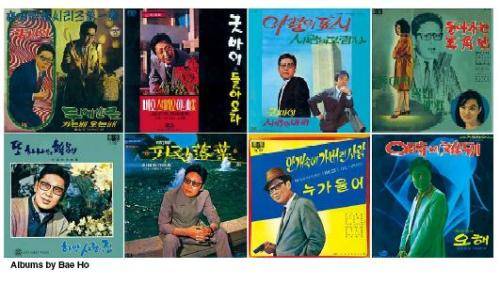
"Then one day I was walking the streets with my head down trying to make sense of the pain of my first failure at such a young age, I heard Bae Ho's 'Ulgo Sipeora (I Feel Like Crying),' playing on a tape deck on top of a rickshaw nearby."
The song in question described rain falling from the skies as a metaphor for a man's tears, telling in lurid detail the series of misfortunes and tough breaks life can throw at someone.
Choi says that was when he got hooked to what is widely known as trot.
"Hearing that piece of music pouring out from that ragged rickshaw got right through the heart. I thought to myself, so this is what music is all about," Choi said as he looked back at a life he says had been mostly spent down on his luck.
"I immediately bought that tape after I heard it and kept playing it over and over. My heart bled through Bae Ho's music. When he sang about rain falling from the skies, you didn't imagine it, you felt it through his voice."
He added that "Because his music had touched me in ways that I'd never been before, I sought out his grave. I wanted to pay my respects to the man who inspired me to get back on my feet."
To track down his grave, Choi contacted the television station that had featured Bae Ho.
After some investigating, he was informed that the body of his idol was buried at the Sinsegye Park Cemetery in Jangheung, Gyeonggi Province.
"When I found out where he was buried, I hopped on the bus immediately," he said. "When I got to his grave, I began conversing with him and just poured my heart out because I felt like he was the only one who could understand my pain at the time."
After Choi made do with his promise he spent the next 20 years visiting his posthumous mentor's grave everyday without fail.
His story became so well known through sheer word of mouth that soon enough crews from KBS and SBS came knocking to cover his story.
"Other people saw me and called me a crazy bastard. I'm not joking," he said.
"And then rumors spread about some weird guy talking and singing in front of someone's grave site and somehow the folks at KBS and SBS got wind of it and started showing up to my daily visits to see if they could cover my story."
Choi, who is now 55 years old, has been a trot singer for 30 years, touring the country singing at nightclubs and events.
One of the most important elements that make for a great trot act, according to Choi, is a singer's choice of wardrobe. "When you step on stage, you don't want to look like any regular person on the street. You want to be colorful," he said. "You don't want people to say 'that ain't no entertainer, that ain't no singer.' So you have to look the part.
"You have to look shiny. Grease up your hair, wear blazers that literally sparkle with sequins and tassles and go up on stage. There is this thing called 'ppodae' and it is a must for a trot singer to have ppodae."
Ppoddae, for the uninitiated, is the Korean equivalent of mojo.
"After you get this ppodae, then you're ready for the stage. Then you look and smell like an entertainer ready to make people happy for that brief moment you perform for them," he said. "The greatest moment for me is when I see my audience react positively to my performance -- when they dance and sing along to my music and I see how happy I've made them."
Hard knock lifeBut the life of a trot singer is no cakewalk.It is a pride-swallowing siege for most "moonlight" singers, who perform from dusk to dawn for less-than-generous fees.
"Unless you're a superstar, most unknown singers are paid around 300-500,000 won per gig," Choi said.
"If a song has hit it big for a singer, a gig at an event doing a three song set will get you between 2-3 million won, but if you're a superstar like Jang Yoon-jung, she can and has been known to get up to 20 million won per set."
According to Choi, he brings in 500,000 won per set.
"I get about 10 gigs a month if the going and the economy is good," he said. "It may seem like good money but after you take out travel expenses, it comes to about 3 million won. You can't really save large amounts being an unknown singer like me."ã
Well-known performers can earn up to 100 million won per month touring the country.
The reality of a no-name trot singer's life is a harsh one.
It is an exhausting job that disrupts the biological clock of many performers.
"For people like us, night and day is flipped," Choi said. "There are times we work until 3 a.m. and by the time we get home, it's already 5 a.m. Guys like me, I don't drink alcohol but there are many that do and it takes a huge toll on their health."
Choi's day begins when he gets up by 2 p.m. He bangs out a few songs as vocal practice ahead of the night's gig and then grabs some food.
"By then, after I'm stuffed and all primped up, it's already time to go to work again. And this becomes a routine. It becomes just another job for most in our racket," he said.
"And for most, we don't take vacation. We get gigs during the holidays like Seollal and Thanksgiving and if you miss one -- what we call committing 'bbang-gu' -- you're on the fast track of being blacklisted by the big nightclub venues around the country."
So what compels him to keep chugging along in such a financially unrewarding profession?
"Looking back, I think sometimes perhaps I've walked a treacherous path, full of pain and financial problems. But this is what I love and have always loved," he said. "So I've told myself repeatedly, I started this thing, so I'll finish it. I want to die doing what I do best and that's singing trot songs."
By Song Woong-ki
Copyright © 코리아헤럴드. 무단전재 및 재배포 금지.