[Rediscover Seoul(75)] Explore the alleys of Seoul's global village
The name Itaewon originated from "i" (梨) meaning a pear and "yeokwon" (驛院) meaning lodging for travelers. In the past, there were many pear trees around Itaewon. During the Joseon Dynasty, it must have been beautiful and breath taking when pear blossoms bloomed and the spring breezes delivered the scent of flowers all around Itaewon. Taking a look at Itaewon now, the streets are blooming with a multicultural vibrancy and crowds bustle through the alleys.
By Lee Sin-hwaFood alley behind Hamilton HotelItaewon has long served as a residential area for foreigners living in Seoul. After Imjinwaeran, the Japanese that remained in Korea stayed in Itaewon. During the Japanese colonization period, all the Japanese resided in the same area.
After the Korean War, Itaewon was transformed into an entertainment area for the U.S. military as the Eighth U.S. Army was based in Yongsan. Itaewon gained popularity around the 1988 Seoul Olympic Games and was designated as a Special Tourist Zone in 1997.
The most bustling part of Itaewon is near the Hamilton Hotel.
You have all the options of world cuisine from Chinese, Indian, Middle Eastern, Italian, French to Belgian, Bulgarian and Mexican. Many of the restaurants also serve brunch menus at lunch time.
Across from the hotel are shopping centers. Eighty percent of the stores are targeted at foreigners, specializing in plus-size clothes, big shoes and party dresses. Itaewon's traditional market is another place you don't want to miss.
From cheap to luxury, you can buy goods at every price level. The market closes every second and fourth Tuesday and is open from 9:30 a.m. to 8 p.m. The owners of 2,000 stores in Itaewon organized the Association of Itaewon Special Tourist Zone (02 797-7319) and the association hosts an annual festival in October (02 710-3320~4, Culture & Sports Div., Yongsan-gu Office).
Alley highlights: There are many restaurants specializing in exotic cuisine, such as Zelen (02 749-0600, Bulgarian restaurant), Mignon (02 793-3070, Belgian-style mussel soup), Santorini (02 790-3474, Greek restaurant), Loco Loca (02-796-1606, Latin bar), La Plancha (02 790-0063, Spanish-style grill dishes), Buddha's Belly (02 796-9330, Thai restaurant), Mogul (02 796-5501, Indian and Pakistani restaurant), Gecko's Garden (02 790-0540, BBQ bar in the outdoor garden). Actor Hong Seok-cheon runs five restaurants, including My Thai, My China and My Chelsea.
If you are looking for French food, Le Saint Ex, (02 795-2465), and Ecume (02 3477-7378), which used to be very popular in Seoraemaeul, Seoul's Petit France, are good choices. An Italian restaurant Cucina Acca (02 790-5486), a casual pub, 3 Alley Pub (02 749-3336), and Sam Ryan's (02 749-7933) sports bar are also famous.
Restaurant hoppers are also directed to Smokey Saloon (02 795-9019) for its juicy handmade burgers and Suji's (02 797-3698) for delicious brunch menus. Ramyeon 81 Myeonok (02 792-2233), Muntaro (文太郞, 02 796-7232, Sake bar), Goamsikdang (02 796-1813 Korean, Budaejjigae) are more choices in Itaewon.
Antique Alley and African marketFrom the Hamilton Hotel, cross the road and go straight toward Bogwangdong to find Antique Alley. The antique shops started opening here 40 years ago when the U.S. soldiers returning home sold their furniture. More than 100 antique furniture shops now attract customers, young people and designers looking for something different.
Then, let's turn to Ihwasijang. Since there are only a few street stalls, Ihwasijang is relatively quiet. A foreigners' bar, a foreign exchange booth, a Korean restaurant, and an Iranian restaurant can all be found here. Obscure alleys also give off their charms.
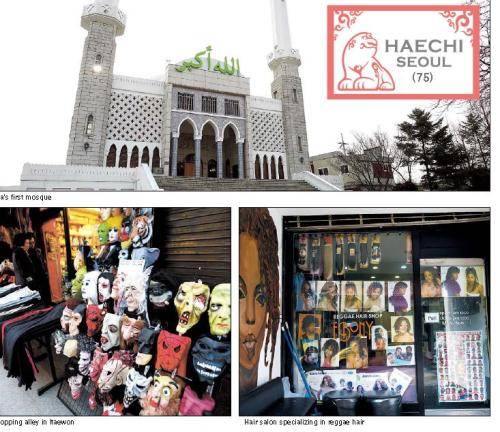
Alley highlights: There are two hair salons specializing in dreadlocks, including Ebonny. An African restaurant, Chajeanks Delight, a kebab store, and Iranian restaurants offer water pipes are good spots to visit.
Gay Hill, Muslim Alley and MosqueGetting out of Ihwasijang and heading toward the fire station will lead you to the roadside. The signs catching our eyes are Trance and Gay Bar. That's why this area is called Gay Hill. The street is filled with homosexual and transgender people on weekend nights. This is something you can see only in Itaewon.
After passing Gay Hill, Muslim Alley appears. Here Korea's first mosque is located. The path toward the mosque is Muslim Alley, with restaurants and grocery stores specializing in Muslim cuisine, an Islamic book café, and a travel agency specializing in Islamic countries.
This area is a small Muslim world with turbaned men all around. They must have come from Pakistan, Bangladesh, and Indonesia as well as Central Asia and the Middle East. At the top of the hill is the mosque. The mosque is located at the top of Itaewon and looks down on the roofs of houses. Despite the fact it is more than 30 years old, the dome is still in good shape. The land for the mosque was donated by the Korean government, and the construction and operational costs were donated by Muslim countries from all over the world. Prayer services are held five times a day, and the Friday worship at 1 p.m. is mandatory for all Muslims.
Alley highlights: How about experiencing Muslim culture by eating Turkish delights and looking around a Muslim bookstore and grocery store? Look for the halal symbols.
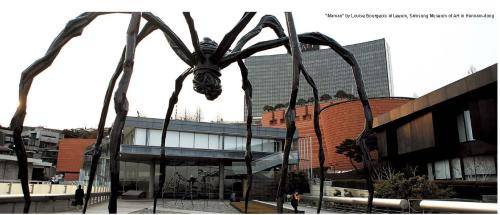
Leeum art museum; Gyeongnidan-gilItaewon continues to expand east and west. The east side of Itaewon-ro, beyond Cheil Worldwide, is a luxury district. Areas around Leeum, Samsung Museum of Art (02 2014-6900, www.leeum.org), the Grand Hyatt and Gyeongnidan (Korean Army Finance & Accounting Corps), are where the luxurious spots are located.
The buildings themselves are pieces of art created by world-renowned architects -- Mario Botta, Jean Nouvels, and Rem Coolhaas. The outdoor exhibition space with its huge spider sculpture is also an eye-catching spot.
Leeum is the most Korean place in Itaewon. The inside of Leeum is divided into two sections, the Samsung Child Education area and the Culture Center. Visitors are first directed to the fourth floor and view the exhibits while walking down the spiral stairs.
Leeum is also famous for its collection of national treasures, ranging from the prehistoric era to the Joseon Dynasty. There are more than 100 ceramic pieces, paintings and calligraphies and Buddhist works. In addition to these are modern and contemporary artworks from home and abroad.
Up the hill from Leeum, there is a residential complex for foreigners. This area is known as the richest village in Korea. Since there are not many passersby, it is a good place for a quiet and peaceful walk. Around the top of the hill is an imported book store and restaurants along the road toward the Grand Hyatt. These restaurants are luxurious and expensive.
Now, let's turn toward Gyeongnidan-gil. It is the west side of the main street of Itaewon. Chic shops and restaurants continue to appear through Haebangchon. The shops and restaurants here are upscale versions of those in Itaewon. The peaceful atmosphere, great taste, reasonable prices and great service are the reasons why people who know Itaewon prefer this area.
Alley highlights: There are a variety of restaurants around the Grand Hyatt, including La Cucina (02-794-6005 www.la-cucina.co.kr), Blossom (02-790-1179, flower café), ad LOCUM (02-790-1831, New York style brunch), Bison (02-790-0479, French cuisine), Petite France (02-790-3040 www.petitefrance.co.kr), and China Town (02-798-4656 www.ichinatown.net). On Gyeongnidan-gil is MAO (02-793-8845, Beijing duck), Bistecca (02-792-7746, Italian restaurant specializing in steak), JELL (02-797-6846, wine specialty shop with its own winery), Gayarang (02-797-4000, Korean royal court cuisine), Hatori Kitchen (02-792-1975, Japanese pub), Kaffa Buns (02-795-7566, hot dogs), and Mi Madre (02-790-7875, Spanish dishes). In addition, the charcoal BBQ restaurant near Gyeongnidan Sijang is very popular with foreigners.
Foreigners in ItaewonItaewon is a place where you can meet people from all around the world. I met people from South America, the United States, Great Britain, Greece, Turkey, Germany, Pakistan, Thailand and the Philippines.
Vincent Sprenger, 27, whom I met at Leeum, is from Germany and studies architecture. He said that he was not able to fully understand Leeum, but the buildings were great. He traveled to Japan and took a ferry to Busan before coming to Seoul. He complimented Korea for its travel infrastructure and said that it was much more convenient than Japan's. He and I explored Itaewon together, eating samgyeopsal and kimchi and experiencing Turkish water pipes.
I also met Luke Eaton, 22, from the United States, at Leeum. He is an instructor at a private English institute. He commented that he loved the museum and paintings in the literary artist's style. He went on to mention that his favorite Korean food was charcoal BBQ, and he wanted to visit Jeju Island. He left Itaewon to meet his friends, saying that he preferred Gangnam or the Hongik University area for meeting friends.
A Turk, Ozcan Nepes, 35, who was making kebabs, said he has been living in Korea for 10 years. Seoul Tower made him stay.
On the street, I also met two tourists from the Philippines who really enjoyed traveling in Korea, particularly Itaewon. I also met a transgender woman from Thailand at an Iranian restaurant who boasted about her language skills, saying that she could speak six languages thanks to her Swiss boyfriend.
Travel Data: Subway line 6 passes through the Itaewon area. (Tourist Information booth is located outside of Itaewon subway station. Tel: 02-3785-0954, 2514.) Noksapyeong Station and Hangangjin Station are better if you want to go to Gyeongnidan and Leeum, respectively. For parking, public parking lots are cheaper.
Lee Sin-hwa is the author of "Best Places to Travel with a DSLR Camera" (www.sinhwada.com) - Ed.
Copyright © 코리아헤럴드. 무단전재 및 재배포 금지.